

When Recovery and Everyday Life Collide: How Virtual Support Bridges the Gap
John Denver’s ‘Take Me Home, Country Roads’ doesn’t really end when the song does. It’s about the pull of home, the desire to return to something familiar, even when you know you’re not quite the same person anymore. That same tension defines life after treatment or rehab for many. It’s a moment of strength, progress, and readiness to move forward in both mental health and substance use treatment. And yet, it can feel like standing at a crossroads, where recovery and everyday life suddenly collide.
On one side is the structure that made healing possible: consistent routines, clinical support, peer connection, and a community built around shared accountability. On the other hand, everything is waiting back home: jobs that didn’t pause, families that still need care, financial responsibilities, and environments that may not yet reflect the growth that has taken place.
The sudden shift from a protected space back into daily life, where support is no longer built into the schedule, is one of the most vulnerable phases of recovery. The challenge isn’t a lack of motivation or commitment, or that care disappears after discharge. It’s that the way care is accessed no longer fits the realities of everyday life.
A difficult choice often follows: remain close to where recovery began and build a sober support network, or return home and try to rebuild that sense of connection from scratch. Thankfully, providers recognize that recovery doesn’t stop at discharge, and support has to adapt alongside it. This is where virtual continuity of care begins to matter.
The Stretch…
- The reality of life after rehab
- Why the transition is so challenging
- Virtual support as a bridge
- Staying connected from anywhere
- Reducing relapse during re-entry
- Moving forward in recovery
A look at the stretch of road after rehab, the pressure points, the moments where support thins out, and what helps recovery hold as everyday life resumes.
The Reality of Life After Rehab
Isn’t there supposed to be relief in being home, sleeping in familiar beds, walking the same streets, and seeing the faces you know again? But few things prepare you for the emotional whiplash that can follow, including heightened anxiety, unresolved emotional triggers, and the absence of daily practices like mindfulness once the structure of treatment is gone. In rehab, recovery is the center of the day, and support is built into the schedule.
Therapy sessions, group conversations, check-ins, and routines create a rhythm that holds everything together. At home, all of that suddenly has to share space with everything else. That shift can be unsettling. The issue is that traditional aftercare models often assume a level of flexibility many people don’t have once daily life resumes.
In-person sessions may require time off work, long commutes, or childcare arrangements. Alumni events can be meaningful, but distance and scheduling conflicts make consistency hard. There’s also an emotional layer that’s harder to quantify. During treatment, recovery is reinforced through shared language and daily connection.
Returning home can mean stepping back into environments that haven’t changed, while losing the immediacy of peer support. Many people describe this phase as being caught between two identities: who they were before treatment and who they’re becoming now. They’re no longer in crisis, but they’re not fully settled either. Confidence exists, but so does doubt. Motivation is present, but so is fatigue.
Clinically, this is a well-recognized transition point. Research consistently shows elevated risk in the period immediately following discharge, not because people stop caring about recovery, but because the environment changes so dramatically.
Why the Transition Is So Challenging
The simplest explanation is the abrupt change in context. In treatment centers, days follow a clear routine. Decisions are simplified. Support is visible and immediate. Progress is reflected back through clinicians, peers, and regular feedback. At home, that scaffolding can fall away almost overnight. Recovery skills don’t disappear, but they’re suddenly expected to work in far more complex settings.
People are asked to apply what they’ve learned while managing:
- Workplaces with deadlines, expectations, and work pressure
- Family dynamics that may still be strained or healing
- Financial responsibilities that return all at once
- Social environments are tied to old habits or emotional triggers
For individuals managing both mental health conditions and substance use disorders, this can feel like being tested before the ground feels steady. Progress also becomes quieter. Inside treatment, improvement is named and reinforced. Outside, validation is less frequent. People may be doing well, but without those touchpoints, uncertainty can creep in.
When multiple stressors arrive at once, even positive ones like returning to work or rebuilding relationships, they can overwhelm coping strategies that are still new. Common experiences during this phase include feeling emotionally “up and down,” becoming easily overwhelmed, struggling to balance recovery needs with responsibilities, or feeling isolated even when surrounded by others.
And this sets the stage for telehealth and virtual support to play a more central role as part of a broader digital turn in behavioral health care that prioritizes continuity over proximity.
Virtual Support as a Bridge
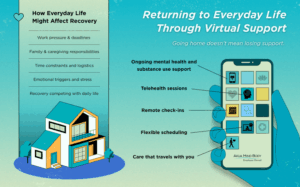
Virtual support after rehab emerged as a response to changing recovery needs. As more people returned home after treatment to jobs, families, and responsibilities that couldn’t be put on hold, it became clear that care tied strictly to location and rigid schedules wasn’t always sustainable. What people needed was continuity that could move with them.
This shift has been especially meaningful for individuals balancing recovery with caregiving, employment, or specialized needs, such as telehealth for Veterans and First Responders, where access and continuity are critical.
Recent data helps explain why virtual support has become central, not optional.
- Virtual care is now how most mental health treatment actually happens: Roughly 58% of all mental health appointments are conducted via telehealth, reflecting how virtual care has become integrated into everyday treatment rather than reserved for exceptional circumstances.
- Telehealth has become a primary access point for substance use disorder care: Data show that approximately 3.6 million people receive substance use treatment through telehealth each year, placing virtual care alongside traditional outpatient services rather than behind them.
- Consistency improves when access barriers are removed: Studies indicate that remote check-ins and teletherapy are associated with higher participation in continuing care compared with traditional outpatient referrals alone, particularly when travel time, work schedules, or caregiving responsibilities would otherwise make engagement difficult.
- Early engagement data in virtual SUD programs is especially telling: In telehealth-delivered intensive outpatient programs, nearly 80% of participants remained engaged at 30 days, with many achieving early abstinence benchmarks, suggesting that virtual formats can function as a viable and effective form of continuing care.
These numbers reflect how telehealth isn’t just filling gaps, but shaping how behavioral health care fits into everyday life. And that matters most during re-entry, when recovery has to coexist with work, family, and responsibilities that don’t slow down.
In practice, telehealth changes how care functions during re-entry:
- Care becomes less location-dependent, allowing continuity even as people return home or relocate
- Structure becomes more adaptable, with clinical touchpoints flexing around real-life demands
- Intervention windows widen, making earlier support possible before stress compounds
- Continuity extends beyond discharge, rather than fragmenting into disconnected phases
- Co-occurring needs stay integrated, supporting both mental health and substance use as daily life resumes
What matters here is that telehealth fits as it reduces friction at a moment when energy and attention are already stretched thin. And when accessing care feels possible rather than burdensome, engagement is easier to sustain.
Staying Connected From Anywhere
One of the quieter shifts virtual support introduces is how it redefines staying connected. After rehab, connection often becomes conditional, dependent on proximity, time, energy, and logistics. Support may exist, but accessing it can feel like another task added to an already full day. Virtual support changes that dynamic. Instead of asking people to rearrange their lives around care, it allows care to fit into the life they’re returning to.
Therapy sessions don’t require long commutes. Check-ins don’t mean taking time off work. Alumni connections don’t fade simply because someone moved cities or states. Staying connected doesn’t mean constant engagement. It means having reliable points of contact during moments when stress rises, routines wobble, or old patterns resurface.
That flexibility can look like ongoing therapy that adapts to work and family demands, regular virtual check-ins that maintain accountability, continued access to peer or alumni communities, or support during high-pressure moments rather than only scheduled appointments.
When a connection feels accessible, people are more likely to use it. And when support doesn’t require choosing between recovery and responsibility, consistency becomes possible.
Reducing Relapse During Re-entry
There’s also the thing many people worry about most during re-entry, even if they don’t say it out loud: relapse. More often, it builds quietly, through stress, isolation, disrupted routines, and moments where support feels just out of reach. The re-entry period is especially vulnerable because so many changes at the same time.
Consistent connection after discharge has long been associated with better outcomes in both mental health and substance use care. The challenge has never been knowing that support helps; it’s been maintaining that support once life accelerates. Telehealth shortens the distance between stress and support.
When access is easier, people are more likely to reach out earlier, before pressure escalates. That timing matters. Small interventions can interrupt patterns that might otherwise gain momentum. Reducing relapse during re-entry isn’t about constant monitoring. It’s about availability. Knowing support is reachable and responsive changes how people move through difficult moments.
Moving Forward in Recovery
As you move forward after rehab, the question isn’t whether the work continues; it’s how the work you began in treatment is meant to move outward into your home, your workday, your relationships, and the routines that define everyday life. Virtual support and telehealth have changed what that handoff can look like, helping continuity travel with you rather than stop at discharge.
At Akua, this understanding guides how we approach care beyond discharge. For us, recovery is an ongoing process that needs flexibility, consistency, and responsiveness, especially during the months when life speeds up. Our support is designed to adapt alongside people, not fall away as independence grows, so if you ever need to reach out and explore what continued support can look like, that door stays open.
Moving forward in recovery is about staying connected long enough for new patterns to take root. And when care continues to meet people where they are, recovery has space to become not just possible, but sustainable.
Related Akua resources
For ongoing step-down care, Akua also offers an intensive outpatient program and dual diagnosis treatment for people balancing recovery with mental health needs.
You might also like

AKUA Mind and Body – women’s residential treatment center has been ranked in the top seven in Newsweek’s 2021 list of the best addiction treatment centers in California
Reading Time: 2 MinutesThe entire team at AKUA Mind and Body is incredibly proud of how dedicated our staff works daily to provide the best treatment services possible for our clients and their families. In addition, we congratulate our fellow addiction treatment centers, who were also ranked in California’s top 80 treatment centers. AKUA Mind and Body-women’s residential […]

The Power of Nature in Healing
Reading Time: 3 MinutesThe Power of Nature in Healing: How Green Spaces Can Transform Your Mental Health Ever just stepped outside? Even for a minute or two? And felt your mood completely shift? Like the very air somehow feels… different? Believe me, it’s not in your head. There’s this raw, undeniable power about nature, about simply being around […]

Unveiling the Role of Spirituality in Addiction Recovery
Reading Time: 3 MinutesSubstance abuse has had a devastating impact on the lives of millions in the United States. As substance use and abuse continue to ravage communities, researchers are working on treatment approaches that can ensure a successful recovery from addiction. Religious beliefs and spiritual practices in preventing use and relapse were commonly thought of in the […]