
Mindfulness for Anxiety: Simple Techniques to Hit Pause on Your Racing Thoughts
How do we even describe anxiety, a feeling that’s different for everyone? We could quote clinical, psychological or philosophical definitions, but on a personal level, it hits like this: your heart races, thoughts scatter, and even small tasks feel impossible, like your brain’s a hamster wheel spinning out of control. Ordinary stress tags along as anxiety’s sneaky sidekick, turning everyday hurdles into waves of overwhelm.
If you’re looking for ways to manage these overwhelming moments, mindfulness for anxiety offers practical, science-backed strategies to regain calm and focus. In the U.S., about 67% of adults say they feel anxious about current world events (American Psychiatric Association, 2025), and for many, anxiety has become a near-constant companion.
Here in California, where tech dreams meet ocean tides, mindfulness is quietly taking root. Teens, especially, are caught between anxiety, constant scrolling, remote work, and climate worries. For many, it’s the only space that feels real. A calm that’s honest, not forced. From quick breathwork to deeper meditations, these practices can help you hit pause on racing thoughts.
A quick heads-up: The techniques discussed here can bring calm, but they don’t replace professional care. If anxiety lingers or starts to weigh you down, a mental health professional or Akua’s supportive programs can make a difference.
Here’s what we’re taking a closer look at:
- Understanding Mindfulness for Anxiety Relief
- Eastern and Western Philosophies Behind Mindfulness
- Core Mindfulness Techniques for Anxiety
- When Professional Guidance Helps
Understanding Mindfulness for Anxiety Relief
Anxiety isn’t just the stress before a big meeting or a restless night before a deadline. Clinically, it’s defined as a feeling of intense worry or fear that can interfere with daily life. Common symptoms include a racing heart, tightness in the chest, rapid thoughts, restlessness, trouble sleeping, and difficulty concentrating.
While occasional anxiety is part of being human, chronic anxiety can chip away at focus, sleep, and decision-making. This is where mindfulness for anxiety comes in. As Jon Kabat-Zinn, the pioneer of modern mindfulness practice, famously said:
“Mindfulness is the awareness that arises from paying attention, on purpose, in the present moment, and non-judgmentally.”
Mindfulness isn’t just a philosophical idea or something reserved for yoga retreats. Even small moments, like a few minutes of mindful breathing before a meeting, can help regain focus and bring a sense of calm during a hectic day. So how did we end up with these little practices that can quiet a racing brain?
It all traces back to Eastern and Western philosophies that have influenced modern mindfulness.
Eastern and Western Philosophies Behind Mindfulness
Mindfulness might feel like a modern trend, but its roots run surprisingly deep. In the East, practices like Yoga, Vipassana meditation, and Metta meditation have guided people for thousands of years, helping them develop awareness in a simple but powerful way: paying attention to the present moment and noticing thoughts and sensations without judgment
In the West, modern adaptations like Mindfulness-Based Stress Reduction (MBSR), progressive muscle relaxation, and reflective journaling provide effective means to focus with clarity. These practices blend age-old wisdom with scientific understanding, giving you flexible ways to manage stress, settle thoughts, and bring a little calm into daily life.
With these ancient and modern philosophies in mind, it’s time to get practical. Let’s dive into the mindfulness techniques for anxiety that you can actually use in your day-to-day life.
Core Mindfulness Techniques for Anxiety
There’s no shortage of mindfulness practices out there; you’ve probably seen a dozen apps, articles, and classes promising calm. The truth? What works can differ from person to person. Some practices have centuries of tradition behind them; others are modern adaptations. Here, we focus on some of the most widely accepted techniques that people actually find helpful.
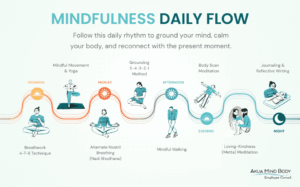
1. Breathwork: The 4-7-8 Technique
Breath has always been at the heart of calming practices, from ancient yogic pranayama to modern mindfulness routines. Dr. Andrew Weil brought this wisdom to a simple, approachable technique called the 4-7-8 breath. The magic happens when you focus on each phase of your breath, inhale, hold, exhale, and let your mind follow along.
- Inhale deeply through your nose for four counts
- Hold your breath for seven counts
- Exhale fully for eight counts
- Repeat this cycle four times
As you move through these breaths, your chest begins to feel lighter, your heartbeat slows, and racing thoughts ease. The beauty of this technique is its portability; you can practice it at your desk, in bed, or even in line at the grocery store. No professional guidance is needed, though awareness and consistency deepen the effects.
2. Grounding: The 5-4-3-2-1 Method
Sometimes anxiety feels like a twister, leaving your body tense and your mind spinning out of control. Grounding helps bring your attention back to the present, and the 5-4-3-2-1 method does just that by engaging your senses. Mindfulness-based stress reduction practices have long used sensory awareness to anchor attention, and this method is both simple and powerful.
- Identify five things you can see around you
- Touch four objects nearby, noticing textures
- Listen for three distinct sounds
- Notice two smells in your environment
- Taste one thing, even if it’s just a sip of water
As you follow this sequence, anxiety softens. The present moment becomes your anchor, and the world outside the hamster wheel comes into focus.
3. Alternate Nostril Breathing (Nadi Shodhana)
In ancient Hindu traditions, Nadi Shodhana is practiced to balance energy channels and harmonize the mind. Alternating your breath between nostrils slows mental chatter and reduces tension, creating a subtle sense of equilibrium. As a beginner, you may find rhythm challenging at first, so some guided instruction helps.
- Close your right nostril and inhale through the left
- Switch and exhale through the right nostril
- Repeat for several cycles
With practice, focus returns, and this technique can be seamlessly added to your morning routine, before bed, or ahead of stressful moments, offering a quick reset anytime.
4. Body Scan Meditation
Vipassana, one of the oldest Buddhist meditation practices, teaches that observing the body without judgment builds awareness and eases anxiety. One practical way to experience this is through a body scan, which brings attention to subtle sensations you might usually overlook, gently drawing your mind away from racing thoughts.
- Lie comfortably on your back or in a chair
- Slowly move your attention from your toes to your head
- Notice sensations like warmth, tension, tingles, without labeling them as good or bad
As your awareness travels through your body, it has a soothing effect, and anxiety and tension melt away.
5. Loving-Kindness (Metta) Meditation
Metta meditation is a gentle way to cultivate compassion for yourself and others. By silently repeating phrases of goodwill, you slowly shift from tension to acceptance and warmth.
- Sit quietly and silently repeat: “May I be safe, may I be peaceful”
- Gradually extend these wishes to friends, strangers, and even challenging individuals
The repetition helps dissolve self-judgment and nurtures emotional resilience. While guided sessions can deepen the practice, even a few minutes alone can help shift anxious patterns.
6. Mindful Movement & Yoga
Ancient yogic traditions remind us that the body and mind are interconnected. Mindful movement anchors your awareness in physical sensations, letting tension release as breath flows with motion.
- Move slowly through postures or stretches
- Sync each movement with your breath
- Pay attention to how your body feels with each motion
A short session can calm nerves, improve focus, and release anxious energy.
7. Journaling & Reflective Writing
Writing down thoughts externalizes worry, helping you observe patterns and gain perspective. Reflection through journaling can clarify what’s really bothering you, reducing anxiety’s grip.
- Write freely about your current thoughts and feelings
- Use sentences like “What is worrying me now?” or “What can I control?” to begin
- Reflect on recurring patterns or insights without judgment
For those with persistent stress, pairing journaling with therapy-guided exercises can provide a deeper understanding, though the practice can stand alone as a simple daily reset.
8. Mindful Walking
A walk can be more than just movement; it can be a moving meditation. Mindful walking brings your attention to each step, your posture, and your surroundings, shifting focus away from anxious loops.
- Walk slowly, noticing each step and shift of weight
- Observe your breath and posture
- Take in your surroundings, the colors, sounds, textures, without judgment
Whether done solo or in a guided walking group, this practice transforms a routine stroll into a calming ritual.
When Professional Guidance Helps
Now that we’ve seen what anxiety feels like and a few mindfulness techniques to try, from breathwork and grounding to body scans and mindful movement, pretty much a handy set of practices to calm your mind whenever it starts racing.
But sometimes that’s not enough on its own. If anxiety is persistent, overwhelming, or just too heavy to handle alone, reaching out to a trained professional or an institution like Akua can really help.
Look out for signs like:
- Anxiety disrupting sleep, work, or daily life
- Chest tightness, racing heart, or other persistent physical symptoms
- Thoughts or worry, when feelings are unbearable
- Panic attacks or sudden bursts of intense fear
- Feeling isolated, hopeless, or unable to cope alone
- Mindfulness practices are not easing tension despite consistent effort
Remember, Mindfulness for anxiety isn’t a one-time fix, and reaching out is never a setback; it’s smart support on a hard trail. Akua combines mindfulness with professional care, helping you manage anxiety, find clarity, and build resilience.
With practice and support, calm returns, one mindful moment at a time.
You might also like

Having Calculated Fun During the SuperBowl and March Madness
Reading Time: 4 MinutesSome of the biggest sports games, the Superbowl and March Madness, are rapidly approaching, and even if you are not a sports fan, there are so many other festivities that are focused around these games. Office draft brackets, the Super Bowl Halftime show and parties, and let’s not forget, the infamous Super Bowl commercials are […]
Integrative Medicine: A Comprehensive Approach for Mental Health Problems
Reading Time: 2 MinutesTraditionally, behavioral health treatment providers have treated substance abuse and mental illnesses as specifically separate conditions that are solely a substance or mental disorder. However, it has been recognized that substance abuse and mental health issues rarely occur alone. To adequately treat behavioral health conditions, including substance use disorders and mental illnesses, providers have recognized […]
Continuum of Care Cycle
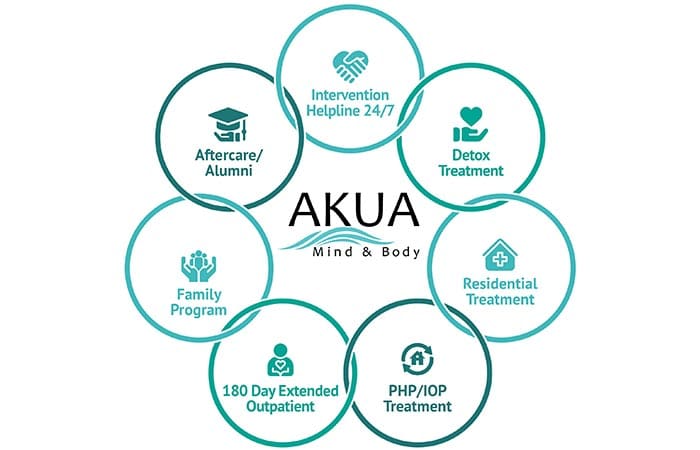
Reading Time: < 1 MinutesContinuum of Care Cycle. At AKUA Mind Body, we are focused on providing you with the help you need. Our treatment programs span across various levels of intensity designed to fit you or your loved one’s needs. With several facilities throughout the Los Angeles & Orange County Region, Sacramento Region, and San Diego Region, we […]