
The Digital Turn:Telehealth for Mental Health and Addiction Is Changing the Way We Heal
Once upon a time, therapy was something you traveled to, through traffic, through waiting rooms, through quiet hallways filled with muted light and resolve. Healing happened behind closed doors, in physical rooms, at scheduled hours. No one imagined it could begin with a login. And yet here we are. Telehealth for mental health and addiction arrived because life changed, and care had to change with it.
There’s a story behind how this all began. By 1959, the Nebraska Psychiatric Institute was already using early videoconferencing to deliver group therapy, long-term psychiatric care, consultation-liaison services, and even medical student training to the Nebraska State Hospital in Norfolk, at a time when television itself was still a novelty in most homes.
What began as grainy black-and-white screens connecting distant clinical rooms would, decades later, evolve into secure video sessions from bedrooms, dorm rooms, military bases, and rural homes miles away from the nearest clinic. Then, after decades of quiet progress, the pandemic thrust telehealth into the center of American healthcare almost overnight.
As the pandemic unfolded, therapy rooms became living rooms and group meetings moved online, and for many, telehealth was no longer a convenience, but the only lifeline in a world suddenly forced to seek connection without closeness. As Anne Lamott wrote, “Hope begins in the dark, the stubborn hope that if you just show up and try to do the right thing, the dawn will come.”
Telehealth hasn’t replaced the heart of recovery, but it has changed how that heart is reached, reshaping how Americans experience care, privacy, connection, and healing in their most vulnerable moments. To understand what this digital shift truly means for patients, providers, and families, let’s walk through how telehealth for mental health and addiction is reshaping care, step by step.
Here’s how that change has taken shape.
- Rise of Telehealth for Mental Health and Addiction
- How Virtual Mental Health Care Actually Works
- Does It Truly Work? Outcomes & Trust
- The Next Chapter of Digital Recovery
- Is Telehealth the Right Fit?
Rise of Telehealth for Mental Health and Addiction
The rise of telehealth is largely attributed to its ability to remove barriers the traditional system never could: long waitlists, workforce shortages, transportation barriers, and the steady weight of stigma. For mental health and addiction care in particular, the screen helped level access by making treatment easier to reach and more private. It also made continuity possible in lives that rarely run on predictable schedules.
Addiction treatment adapted almost instinctively to this shift, as virtual assessments replaced delayed first contacts, therapy and psychiatry moved online without losing their clinical structure, and recovery check-ins became more consistent through digital connection. Group support quietly re-formed in new ways across screens and time zones.
For many, this transition marked the difference between slipping through long-standing gaps in care and staying connected through the most fragile stages of healing. The data now reflects the shift.
- In 2024, more than 61 million U.S. adults experienced mental illness, stretching existing care systems beyond their limits. In response, telehealth moved from alternative to norm, with roughly one in three adults using virtual care in the past year.
- Between January 2020 and January 2021, telehealth availability rose by 77% at mental-health treatment facilities and by 143% at substance use disorder (SUD) treatment facilities, showing especially rapid adoption in addiction care during the pandemic.
- As of early 2025, mental-health conditions accounted for approximately 58.5%–62.3% of all telehealth claims in major U.S. claims databases, making behavioral health the single largest driver of telehealth use nationwide.
In other words, telehealth is no longer something that patients “try.” It is something they depend on. What we are witnessing now is not a temporary digital phase. Telehealth for mental health and addiction has moved from a side option to a main one because it meets people in the reality of their lives rather than in rigid systems.
How Virtual Mental Health Care Actually Works
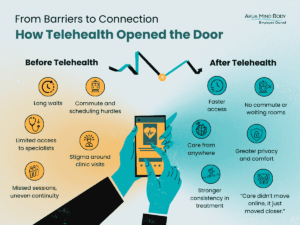
At first glance, virtual care appears simple, almost seamless. But beneath that simplicity exists a carefully constructed system designed to protect the safety, structure, and clinical rigor of in-person mental health and addiction treatment. Telehealth may shrink physical distance, but it does not compromise the standards of care that guide every clinical decision.
At its core, the telehealth journey for mental health and addiction care unfolds through a few consistent stages.
- It begins with a digital intake and screening, where patients complete medical history, mental health assessments, and consent forms online.
- Based on this information, patients are matched with licensed therapists, counselors, or psychiatrists according to clinical needs, location, and insurance coverage.
- All sessions are delivered through secure, HIPAA-compliant video platforms, protecting privacy while mirroring in-person standards of care.
- For addiction treatment, care moves through coordinated layers, starting with remote assessments, followed by one-on-one counseling, online group therapy, and psychiatric support as needed.
- With same-week and even same-day appointments now common, telehealth removes long-standing barriers of distance, time off work, transportation, and public visibility.
What makes this model truly transformative isn’t just the technology itself, but how it quietly turns seeking help from something intimidating and public into something reachable, private, and human, while simultaneously reshaping how care is delivered, how trust is built, and how connection is sustained from the other side of the screen.
The Patient Outlook
For patients, telehealth often feels like care that finally fits into real life instead of competing with it. There is no waiting room, no commute, no explaining absences from work or home. Sessions take place in familiar spaces, a bedroom, a parked car, a quiet corner of the day, where defenses are often lower, and honesty comes a little more easily.
Many patients describe feeling less exposed and more in control, especially in early recovery or during the first stages of therapy. The ability to log in privately, meet consistently, and stay connected through disruptions reduces the risk of dropping out during fragile moments.
The Clinician Perspective
For clinicians, telehealth marked a shift in how therapeutic space is created and sustained. In the early days, familiar questions surfaced about rapport, emotional nuance, and holding crises through a screen. Then patients began showing up. And they kept showing up.
Over time, clear patterns emerged in day-to-day practice:
- Missed appointments declined, as distance, commute time, and scheduling conflicts stopped standing between patients and care.
- Consistency in early recovery improved, especially for patients who previously struggled with regular attendance.
- Family participation became easier, allowing loved ones to join sessions without travel or logistical strain.
- Follow-ups and continuity strengthened, creating steadier therapeutic momentum over time.
At organizations like Akua, clinicians now describe telehealth as care that naturally fits into the rhythm of patients’ lives. The clinical structure remains constant, with the same assessments, the same ethical standards, and the same therapeutic rigor guiding every interaction, but the first step now feels easier, and the ability to stay connected feels stronger.
And as these patterns settled in, a new question moved from the therapy room to the research room: do the outcomes match what clinicians are seeing every day?
Does It Truly Work? Outcomes & Trust
For years, a quiet question trailed the rise of telehealth: Does it work as well as in-person care? Not in theory, not in crisis conditions, but in everyday practice. And across U.S. behavioral health systems, the answer that’s steadily emerged is ‘yes.’ Patients using telehealth for anxiety, depression, trauma, and substance use disorders are now showing outcomes comparable to in-person care, whether in retention, engagement, or relapse-prevention planning.
Among rural patients and individuals in early recovery, continuity of care has often improved rather than declined. But outcomes alone do not explain why telehealth has held its ground. Trust is not built on data points alone. It is built on lived experience. Patients consistently describe:
- Feeling safer opening up from familiar environments
- Having greater control over the pace and process of recovery
- Experiencing reduced shame and exposure anxiety
- Being more likely to stay in treatment long-term
Trust carried through the digital shift, taking on a new form rooted in reliability, stable contact, and the familiarity of returning to the same space, even if that space is a screen. It became something built through consistency and continuity, shaped session by session.
And with trust established, the focus turns to the future, how telehealth will continue to evolve.
The Next Chapter of Digital Recovery
Telehealth is no longer in an experimental phase. It is now entering its hybrid future, where digital and in-person care are no longer seen as opposites, but as complementary parts of a unified system of healing. The next chapter of virtual behavioral health is already taking shape through:
- Hybrid treatment models that blend virtual and onsite care, where people can shift between online sessions and in-person visits depending on what their recovery calls for that day or week.
- AI-supported screening and triage to shorten time to treatment, with digital tools that quickly pick up on symptoms, flag urgency, and route someone to the right level of care without the usual delays.
- Remote relapse-prevention monitoring and follow-up systems, using simple digital check-ins or tracking tools that help spot early signs of struggle so support can reach someone before things escalate.
- Expanded insurance parity across public and private payers, with telehealth covered at the same level as in-person care, making access more stable and predictable for patients.
- Deeper integration into community-based recovery networks, where virtual care connects more directly with local supports, peer groups, clinics, and shelters, so a person’s recovery stays linked to the community around them.
What will not change is the heart of the work. Healing will still require courage, honesty, accountability, and connection. The medium may evolve. The human work beneath it will not. Telehealth is no longer simply reshaping recovery. It is becoming part of its foundation.
Is Telehealth the Right Fit?
Telehealth is powerful. But it is not universal. It tends to serve best those who need consistent care but face logistical barriers, those who feel safer beginning privately, and those who live far from specialized providers or structured programs. For many, it becomes the most realistic path into treatment where no viable alternative exists.
At the same time, there are moments when physical presence remains essential. Acute psychiatric crises, severe medical detox, and situations requiring round-the-clock medical supervision still belong in in-person settings. Telehealth is not a replacement for every form of care. It is a bridge, sometimes temporary, sometimes long-term, often life-opening.
Treatment centers like Akua Mind Body operate along both sides of that bridge, recognizing when virtual care is the safest and most sustaining option, and when in-person intervention becomes necessary. In this balance, digital care finds its truest purpose. What matters most is not the format through which care is delivered, but the simple fact that care becomes reachable at all.
Once upon a time, healing lived only in rooms and hallways. Today, telehealth for mental health and addiction begins with a signal, a screen, and the courage to click “join.”
Related Akua resources
For more structured support beyond telehealth therapy, explore Akua’s virtual IOP in California, in-person intensive outpatient program, and dual diagnosis treatment for co-occurring needs.
You might also like

Ohana Family Support Group- Safeguarding Recovery from Addiction and Mental Illness during the Holidays
Reading Time: < 1 MinutesAndrea Dressler, Vice president of Community Relations at Akua Mind & Body will be facilitating an online event for Ohana Families on the 7th of December 2021. The topic of discussion will be Safeguarding Recovery from Addiction and Mental Illness during the Holidays. Meeting Link: https://tinyurl.com/OhanaSupport Meeting ID: 86543531016 Passcode: 003841 Date: Dec. 7, 2021 […]

In The News: 988 is the New 911 for Mental Health Crises
Reading Time: 3 MinutesThe COVID-19 pandemic was brutal for many individuals and sometimes impossible for those struggling with mental health disorders or addiction. New mental health diagnoses skyrocketed, mental health emergency visits increased, suicide rates, including attempts and deaths, rose, and overdoses cost thousands of lives during this pandemic. Unfortunately, there were and are not enough mental health […]

Embracing Your Inner Child: A Path to Improved Mental Health
Reading Time: 2 MinutesAs we grow older, we often become more serious and focused on the demands of adult life. However, it’s important to remember the joy and wonder of childhood. Embracing your inner child can actually help improve your mental health by promoting creativity, playfulness, and self-expression. Creativity As children, we were encouraged to be creative and […]