
Residential Mental Health Treatment: A Steadier Way Forward Toward Lasting Change
There often comes a point when managing mental health no longer feels like coping, but like survival, as persistent anxiety, depression, trauma responses, or substance use begin to take more out of a person than they give back. When this happens, therapy and medication may no longer feel sufficient for the person experiencing it. And for loved ones, partners, parents, or close friends, it can be just as painful to witness someone fighting an invisible battle while appearing composed on the outside.
Residential Mental Health Treatment often becomes a consideration at this point for many people, a level of care designed for instances when outpatient support no longer meets the depth of need. Think of Pat’s experience in Silver Linings Playbook, where returning home after psychiatric treatment comes with expectations of “normal” life before inner stability has fully returned.
It’s in moments like these, when symptoms remain largely unseen yet steadily intensify, that holding together alone is no longer enough and a higher level of therapeutic presence becomes necessary. Clinically, this is the point where symptoms persist despite outpatient treatment or begin to interfere with day-to-day functioning, relationships, or personal safety.
Residential mental health treatment, often misunderstood as solely addiction-focused, provides a structured therapeutic environment with consistent clinical support and medication management, helping individuals move beyond short-term regulation toward lasting stabilization and recovery. It is a clinically recognized next step when outpatient care no longer meets the depth of need within the mental health care continuum.
Understanding where residential treatment fits, and when it becomes appropriate, helps individuals and families move forward with clarity, rather than fear, as they consider the next phase of care.
- What Residential Mental Health Treatment Is
- Choosing Residential Care
- Why Immersive Treatment Works
- Where It Fits in the Continuum of Care
- Life Inside a Residential Program
- Finally, A Steadier Way Forward
What Residential Mental Health Treatment Is
Residential mental health treatment offers a level of care that sits between crisis stabilization and outpatient therapy. It is immersive, structured, and intentionally designed to support healing without the constant pull of daily life, creating space for the nervous system to settle and learning to take hold.
Rather than isolating people from their symptoms, it provides a contained space where emotional, psychological, and behavioral patterns can be addressed consistently and safely. Therapy is integrated into everyday living, allowing insight to build through repetition rather than being lost between sessions.
At Akua, residential treatment is designed as a therapeutic sanctuary, not an institution. A clear framework exists to support regulation and predictability, while care remains individualized, trauma-informed, and responsive to each person’s needs. This balance allows healing to unfold at a pace that feels supported rather than forced.
Choosing Residential Care
Choosing residential mental health treatment rarely happens because of a single bad day or a moment of weakness. More often, it comes after weeks or months of trying to cope in the real world and realizing that usual support, such as therapy, medication, and routines aren’t enough anymore. The shift is subtle, moving from “I can manage this” to “I’m managing, but I’m barely holding on.”
Many describe it as living two parallel lives: the one everyone sees, functional, composed, maybe even successful, and the one that plays out internally, where anxiety spikes, depression deepens, or trauma responses take over. At that turning point, you may notice:
- What once felt stressful now feels unmanageable. Your emotional baseline has shifted, and your reactions don’t feel like you anymore.
- Outpatient therapy isn’t enough, not because it’s ineffective, but because there’s no space to apply it. You leave sessions motivated, only to return to the same triggers.
- Routine tasks feel harder than they should. Getting out of bed, going to work, or maintaining relationships takes more energy than you have.
- Your internal world starts drowning out your external one. Thoughts race, emotions intensify, and it becomes harder to focus or feel present.
- Loved ones express concern, or you wish they would. Sometimes they notice before you do; other times, you hide it so well no one realizes how much you’re carrying.
This crossroads looks different for everyone. In some cases, it follows detox or addiction treatment. In many others, mental health challenges and substance use coexist, and residential programs are designed to treat both together through an integrated, dual-diagnosis approach rather than addressing one in isolation. For others still, it emerges from mental health challenges alone, without a history of substance use.
Clinically, this level of care often supports individuals experiencing severe or persistent symptoms associated with conditions such as bipolar disorder, PTSD, major depressive disorder, schizophrenia, or severe anxiety, particularly when those symptoms begin to interfere with safety, stability, or daily functioning.
Here is the part many people struggle to accept: choosing residential care isn’t a failure. It isn’t giving up. It is recognizing, with honesty and courage, that you deserve more support than weekly therapy or medication adjustments can offer right now. It is a decision to step out of the breakdown lane before something shatters.
Once endurance becomes unsustainable and safety or daily functioning begins to erode, the focus naturally shifts to why immersive treatment can offer the kind of continuity that outpatient care cannot.
Why Immersive Treatment Works
Residential treatment works because it removes the constant tug-of-war between stabilization and daily life. Most people underestimate the internal labor required to hold themselves together between therapy sessions, managing symptoms, responding to triggers at work and at home, and attempting to apply therapeutic insight without support.
In immersive care, the labor of doing it alone finally pauses. Being held within a supportive mental health community, one that is non-judgmental, consistent, and deeply understanding, allows people to be seen without explanation, comparison, or shame, making peer support an active part of mental health recovery rather than a passive backdrop. Healing becomes the focus rather than something squeezed into the margins.
The setting is predictable and psychologically safe, reducing hypervigilance and emotional reactivity.
- Therapy is frequent and layered, allowing progress to build rather than fade between sessions.
- Support is available throughout the day, making progress more stable and sustainable.
- New behaviors are practiced in real time, turning healing into a lived experience.
At Akua, this process is continuous through trauma-informed care, evidence-based clinical modalities, and holistic grounding practices. As the nervous system steadies, capacity begins to return, creating the conditions for deeper work.
Where It Fits in the Continuum of Care
Understanding where residential mental health treatment fits within the continuum of care often brings the clarity needed to choose care with confidence rather than fear. At one end of the spectrum is acute inpatient or crisis care, designed for immediate stabilization. These short-term settings focus on safety, medical oversight, and symptom containment during moments of acute risk.
Once that immediate danger passes, most people still need therapeutic support to address what led them there. Residential mental health treatment sits in the space after stabilization and before reintegration. It offers immersive, longer-term therapeutic care within an intentionally designed living environment, more contained than outpatient therapy, yet less clinically acute than inpatient hospitalization.
Within the continuum:
- Inpatient or acute crisis care provides short-term stabilization and safety.
- Clinical residential treatment offers planned therapeutic living with intensive clinical support.
- Step-down and transitional care gradually reintroduce independence while maintaining rhythm.
High-quality residential programs, like those within Akua’s continuum of care, integrate mental health and addiction treatment rather than separating them. Some clients enter residential care after detox or addiction treatment, ready to address the emotional and psychological patterns underneath. Others arrive seeking focused guidance for depression, anxiety, trauma, or burnout without a substance-use history at all. In both cases, care is individualized and layered.
Residential treatment is not meant to be an endpoint. As stability grows, clients transition into lower levels of care that support real-world reintegration while preserving therapeutic momentum. This continuity ensures that progress doesn’t end at discharge; it evolves.
Life Inside a Residential Program
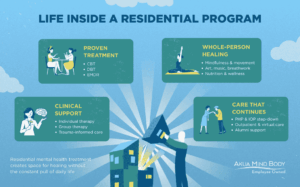
A typical day balances therapeutic depth with space to breathe. It may include individual therapy to untangle long-standing emotional patterns, group sessions where shared experience replaces isolation or shame, and skill-building work focused on regulation, communication, and emotional resilience. Alongside this, holistic practices invite the body back into the recovery process, not as an afterthought, but as an essential part of recovery.
Key elements of daily care often include:
- Individual therapy to explore patterns, triggers, and emotional history
- Group therapy that normalizes experience and reduces shame through shared understanding
- Skill-building sessions focused on emotional regulation, communication, and resilience
- Holistic practices such as mindfulness, movement, art, music, or breathwork
What makes residential mental health treatment effective is the way clinical and holistic approaches are intentionally woven together. Evidence-based therapies provide structure and insight, while experiential practices help those insights land in the body. Together, they allow healing to become lived rather than intellectual.
Clinical foundations commonly include:
- Cognitive and behavioral therapies (CBT) that help reframe entrenched thought patterns
- Dialectical approaches (DBT) that build emotional and interpersonal regulation
- Trauma-informed care, including modalities such as Eye Movement Desensitization and Reprocessing (EMDR), is designed to process unresolved trauma
- Family therapy, when appropriate, to address relational dynamics alongside individual work
These evidence-based therapies, including CBT, DBT, and EMDR, are widely supported by clinical research for their effectiveness in treating trauma-related conditions, mood disorders, emotional dysregulation, and PTSD.
Holistic and expressive supports deepen this work by bridging insight and embodiment:
- Mindfulness and grounding practices that restore nervous system regulation
- Movement-based therapies, including yoga or somatic work
- Art and music therapy as nonverbal pathways to expression
- Nutrition and wellness support that reinforces physical stability
Just as importantly, support does not end when residential care does. Akua’s continuum of care ensures progress is carried forward rather than abruptly interrupted:
- Partial hospitalization and intensive outpatient programs that maintain structure while independence grows
- Outpatient and virtual care to support ongoing stability
- Alumni services that preserve connection and accountability beyond treatment
This gradual step-down prevents the sudden gaps that can make recovery feel fragile. Instead, recovery becomes something you move through with guidance, consistency, and time, not something you are expected to figure out alone.
Finally, A Steadier Way Forward
Residential mental health treatment isn’t about escaping life; it’s about rebuilding it with clearer eyes and steadier hands. It gives the nervous system a chance to reset, the heart a place to tell the truth, and the mind the space to learn a new way of being. Some people arrive carrying depression, some anxiety, and some trauma. But all of them carry hope, even if it’s quiet, even if it’s small.
Programs within Akua across California create the conditions where hope can steady and grow. Over time, that stability allows people to reconnect with themselves, sometimes returning to a familiar sense of self, sometimes discovering it for the first time. Healing is carried forward through sustained motion rather than isolated moments.
Residential care can be an important part of that motion, offering the stability and support needed to move forward with care and continuity.
Related Akua resources
People comparing residential care can also review Akua’s mental health treatment in San Diego, mental health treatment in Costa Mesa, and dual diagnosis treatment options.
You might also like

Unveiling the Role of Spirituality in Addiction Recovery
Reading Time: 3 MinutesSubstance abuse has had a devastating impact on the lives of millions in the United States. As substance use and abuse continue to ravage communities, researchers are working on treatment approaches that can ensure a successful recovery from addiction. Religious beliefs and spiritual practices in preventing use and relapse were commonly thought of in the […]

I Think I Need to Stop Drinking
Reading Time: 3 MinutesI think I need to stop drinking. Has this thought ever crossed your mind? Many people reach a point where they begin questioning their drinking habits and wonder if they might be an alcoholic. Maybe you are a functioning alcoholic? Most people do not decide to quit drinking completely without a catalyst like the loss […]

Reclaiming Your Sleep
Reading Time: 2 MinutesReclaiming Your Sleep: Real Talk for Restful Nights and Brighter Days Ever find yourself waking up feeling… well, like you’ve just run a marathon in your sleep? You know that tired-but-wired sensation? Or maybe you’re just endlessly watching the clock tick past midnight, again. If truly restful sleep feels like a fantasy lately, let me […]