

Understanding the Detox Process Beyond Getting Clean
Detox is one of those words we hear so often that we stop hearing it at all. It becomes shorthand for something clinical, cold, and stripped of feeling, a sterile room, a narrow bed, a body shaking its way through withdrawal while a clock ticks loudly in the background. But the real story of the detox process is seldom told, perhaps because it’s harder to narrate than a medical definition, and because the truth sits somewhere between the body and the mind, between chemistry and memory.
To understand detox, we have to understand what it used to be. Centuries ago, when someone drank too much or used too much, they weren’t taken into care; they were taken to holding cells. Concrete, steel bars, and a thin blanket if the guard felt generous. People shook alone, hallucinated alone, sweated alone, because withdrawal was treated as punishment, not physiology.
It’s only after medical bodies began acknowledging addiction as an illness, not misconduct, that detox shifted from a jail cell to a monitored room, from shame to treatment. It’s about the emotional exhale that happens when someone realizes: I don’t have to fight my body tonight. Someone else is holding the line with me.
And from here, the deeper work of understanding begins:
- What Detox Really Is
- The Emotional Underlayer of Detox
- The Different Faces of Detox
- Inside the Detox Process
- What Comes After Detox
- AKUA Honors Both Body and Mind
It begins by asking, with more honesty than most definitions allow, what detox truly is and what it asks of a person in both body and mind.
What Detox Really Is
If you ask ten people what detox is, you’ll get ten versions of the same incomplete story. Some will say it’s “getting the substances out,” others will say it’s withdrawal, and some will shrug like it’s just a mandatory checkpoint before the “real work” of recovery begins. But detox is much more intimate than any definition allows. Clinical guidelines try to capture it, but they can only outline the framework.
According to SAMHSA’s Treatment Improvement Protocol (TIP 45), one of the federal guidelines that shapes how clinicians understand detox, the process unfolds in three movements:
- Evaluation: understanding what’s in your system and what else you might be carrying, emotionally or medically.
- Stabilization: guiding you safely through withdrawal, sometimes with medication, always with intention, so the process doesn’t become its own kind of danger.
- Transition Into Treatment: helping you step into ongoing care, because clearing the body is only the beginning, not the cure.
In essence, detox is less about the shaking body we imagine and more about preparation, protection, and the quiet promise that you don’t have to go through this alone. That explanation works, but it doesn’t tell the whole story. It’s like saying rainfall is “just water falling from the sky.” Technically true, but it misses everything that matters.
Detoxing is the body remembering itself. After months or years of being pushed beyond its limits, living in survival mode, reshaping its rhythms around dependence, the body finally pauses, and in that pause, its true rhythms surface again, slowly and awkwardly, like a language forgotten and relearned.
The nervous system recalibrates as sleep returns, appetite stirs, and muscles long clenched begin to loosen. Yet detox is just as much the mind waking without the buffer it once leaned on, an awakening that can feel gentle or jarringly raw as thoughts arrive unfiltered, memories shift, and feelings long numbed return almost like strangers at the door.
This dual unfolding is why the most accurate answer to “What is detox?” is both simple and complicated; it is the body rebuilding its sense of safety while the mind restores its sense of presence, two parallel recoveries unfolding in the same hopeful breath.
The Emotional Underlayer of Detox
People rarely talk about the emotional weather inside detox. They talk about symptoms and safety and protocols, but they forget the internal landscape, the place where shame, grief, fear, and relief all arrive at once. That’s why the setting matters so deeply. At AKUA, detox doesn’t feel like punishment or a cold clinical intervention. It feels like stepping into a quiet room after a long storm and realizing you’re not alone.
As substances fall away, emotions rise quickly, making detox the first place they’re finally allowed to be felt. They aren’t symptoms but stories returning, finding their voice again in the safety of that space. And because they come forward so fast, the emotional side of detox is held with the same steadiness as the physical, out of respect for what reappears when the numbing lifts.
Each substance brings its own physical story as well, which is why detox never unfolds the same way twice.
The Different Faces of Detox
Detox is not the same for everyone. Different substances affect the body in different ways, so withdrawal looks and feels different depending on what someone has been using. Detox responds to what the body has adapted to over time. For instance…
Alcohol Detox
Alcohol detox asks the body to regain its regulatory balance after years of relying on a depressant that softens anxiety while slowly destabilizing the nervous system.
- Withdrawal can escalate quickly, as the body must stabilize without alcohol’s constant presence, a shift that seems simple but can become medically dangerous without warning.
- Anxiety, tremors, and autonomic instability may surface rapidly, requiring close monitoring to prevent complications such as seizures or delirium tremens.
- As the nervous system recalibrates, it begins firing unevenly, creating a withdrawal landscape that demands vigilance and steadiness from clinical staff.
Benzodiazepine Detox
Benzodiazepine detox, whether from Xanax, Ativan, Valium, or Klonopin, moves quietly on the surface but hides an intense neurological recalibration underneath.
- The brain, conditioned to rely on benzos for calm, reacts to their absence with sudden spikes of fear, agitation, and internal tension.
- Withdrawal can bring waves of anxiety, sensory sensitivity, and insomnia that must be eased gradually rather than disrupted abruptly.
- Stabilization requires a slow, carefully paced taper or medication strategy to prevent destabilization and gently guide the nervous system back toward balance.
Stimulant Detox
Detoxing from stimulants like cocaine or methamphetamine takes the body into a state defined not by sharp physical pain, but by deep depletion of energy and emotional tone.
- The crash arrives quickly, replacing artificial peaks with profound exhaustion that makes rest feel unavoidable.
- Emotional flatness, irritability, and a disquieting stillness may emerge as the brain shifts from hyperstimulation back toward baseline.
- Sleep, hunger, and quiet become the first signs of healing, even as motivation and emotional color return slowly and unevenly.
Opioid Detox
Opioid detox, from heroin, fentanyl, prescription opioids, or methadone, often arrives as a full-body reckoning, with the nervous system voicing its protest loudly.
- Aches, chills, stomach distress, restlessness, and overwhelming urgency spread through the body as receptors demand what they can no longer have.
- Though not typically life-threatening, the experience can feel relentless, making consistent, compassionate medical support essential.
- Improvement begins with steady rehydration, reduced autonomic distress, better rest, and gradual stabilization of physical cravings.
And with each detox speaking its own language, the medical process that supports it must be flexible, attentive, and woven carefully enough to meet every person exactly where their body and mind begin.
Inside the Detox Process
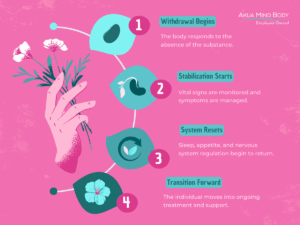
From the outside, detox may look like constant supervision: nurses checking in through the day and night, quiet conversations at odd hours, vitals monitored with steady consistency. But from the inside, it often feels like relief, the sense of not having to watch your own body alone anymore, of knowing someone else is keeping the night watch.
A key part of this process involves standardized withdrawal assessments. CIWA-Ar (Clinical Institute Withdrawal Assessment for Alcohol, Revised) and COWS (Clinical Opiate Withdrawal Scale) are widely used clinical tools that help care teams understand the severity of withdrawal and determine when additional support or medication is needed.
In practice, this medical framework commonly includes:
- Scheduled withdrawal scoring using CIWA-Ar or COWS, typically every four hours, to monitor how symptoms are progressing
- Routine vital sign monitoring, often conducted every four hours, to detect early changes in heart rate, blood pressure, temperature, or breathing
- Medication support when appropriate, particularly during alcohol, opioid, and benzodiazepine withdrawal
- Physician-led oversight, with detox plans reviewed and adjusted based on how the body responds over time
- Continuous clinical observation, with nurses and technicians responding to changes and comfort needs
Yet detox is never only about medication. The body is relearning how to be human again, and that relearning depends on gentler forms of regulation as well:
- A meal arrives when appetite feels uncertain, reminding the body that nourishment is allowed.
- Music or soft sound, giving the nervous system something steady to lean toward.
- Breath slowing in stillness, teaching the mind a rhythm it hasn’t trusted in a long time.
These supports make the hours bearable in ways that don’t appear on charts. The length of detox shifts according to what the body has carried and for how long, because there is no universal timeline, only a gradual easing that begins when the body is ready.
What Comes After Detox
Recovery begins after detox, through therapy and support that help people understand their patterns, face trauma, and learn healthier ways to cope. Without that continued care, the nervous system often reaches for the quickest path back to relief, which is why relapse is not a moral failure but a neurological reflex in the absence of support.
Recovery, after all, is not a single program. It’s a continuum, more like one long thread that carries a person forward, from detox into deeper levels of care, whether that means remaining within the safety of residential treatment, stepping into the structure of partial hospitalization, building consistency through intensive outpatient care, or continuing healing through virtual treatment when returning to daily life.
Detox may be the bridge, but the continuum is the road that carries a person forward, one supported step at a time.
AKUA Honors Both Body and Mind
Here, detox is never treated as a purely physical event. The shaking body may draw urgent attention at first, but the deeper currents, including fear, memory, and the quiet strategies of survival, are recognized as just as real and just as deserving of care. This is where “east meets west” becomes practice rather than philosophy.
At AKUA, medical oversight steadies the body through the detox process, while gentler forms of regulation help the mind settle: breath that deepens, sound that anchors, movement that softens agitation, and presence that reminds a person they are not moving through recovery alone.
No two people move along this thread the same way, so treatment plans are shaped around each person’s goals, health, history, capacity, and readiness for what comes next. Families join the healing process by learning to support without controlling, connect without enabling, and show up without letting fear take the lead.
And through every step of that return, AKUA’s continuum of care stands as the steady ground where the body is supported, the mind is honored, and healing becomes possible again.
Related Akua resources
If withdrawal is part of the care conversation, Akua’s San Diego detox center can support the first step, and its dual diagnosis treatment program can help when substance use and mental health needs overlap.
You might also like

Dialectical Behavioral Therapy: A treatment Approach for Suicidal Behavior
Reading Time: 2 MinutesEven though there is increased information and acceptance of mental health problems, the adversity concerning suicide and self-harm among teenagers is still thriving in America. According to the American Foundation for Suicide Prevention (AFSP), more than 40,000 Americans lose their lives because of suicide every year. Suicide is the nation’s 10th leading cause of death, […]
Is Erasing Memories to Treat PTSD Ethical?
Reading Time: 3 MinutesMemories, although expressed differently, play a central part in our routine life. This includes the evolution of someone’s individuality which is conceived as a consequence of interconnections among memories. Various brain imaging studies have revealed that the part of the brain, called the hippocampus, is known to be crucial for memory formation. This stands equally […]

CELEBRATING ALL DADS ON FATHER’S DAY
Reading Time: 3 Minutes“A father is someone you look up to no matter how tall you grow.” – Unknown. June 19, 1910, is quite a remarkable day in history because it was the very first Father’s Day making this Sunday, June 19th the 112th Father’s Day. While this memorable holiday honors all men who are important in […]