
Mindfulness and Emotional Triggers: How Awareness Helps You Respond, Not React
Haven’t we all had moments we thought would be smooth, but ended in a spiral we never saw coming? We wake up steady, the breath easy, the day unfolding just right, until something small shifts. A comment lands wrong, a tone feels off, a glance lingers too long. It seems minor, but it sticks, rolls quietly through thought, gathering weight.
The ‘moment’ we thought we had in control starts to slip. The balance tips, and you feel it, that old familiar pull beneath the surface, waiting to be understood. That’s how emotional triggers move quietly, precisely, and often without reason that the mind can explain. They’re not signs of weakness or oversensitivity; they’re the body remembering.
The nervous system, shaped by past experiences, confuses an echo of what once hurt with what’s happening now. It sends up alarms to protect you, even when there’s no real danger left to guard against. This is where mindfulness and emotional triggers meet, not as opposites, but as parts of the same story.
It doesn’t ask you to suppress emotion or paint over discomfort with positivity. It asks you to stay, to breathe, to witness what’s unfolding without rushing to fix it. Because that’s what awareness does: it pauses the momentum. It gives emotion a place to land. When you learn to see triggers not as disruptions but as messengers, the mind begins to soften, the body steadies, and awareness becomes your anchor. You stop reacting to what hurts and start responding to what’s true.
A Mindful Look at Emotional Triggers
- When Calm Turns to Chaos
- The Mindful Pause
- The Slow Work of Regulation
- When the Emotion Feels Too Big
- The Return Home
When Calm Turns to Chaos
Triggers are deeply personal, and they don’t announce themselves as they rarely make sense in real time. Say, a colleague’s tone may echo the voice of an old authority figure. A friend’s distance might awaken the ache of earlier rejection. These are not coincidences; they’re the body’s emotional reflexes, rehearsed over years, doing their best to keep you safe.
Psychologists and mindfulness teachers often group triggers into four broad forms, though real life rarely fits neatly into any frame. Still, understanding their nature helps trace the quiet logic of your reactions, how emotion finds its way back into the body.
The most common types of emotional triggers include:
- Internal triggers: Arising from within thoughts, sensations, or memories that surface suddenly. A familiar worry, an echo of self-critique, or a remembered loss can all reignite emotion from within the mind itself.
- External triggers: The sensory cues of daily life, places, sounds, scents, or phrases that awaken old associations. A song, a smell, or a street you once walked can open the door to emotion faster than thought can follow.
- Relational triggers: Born in interaction. The tone of a loved one’s voice, a colleague’s expression, or a gesture that mirrors something from your past can all awaken the body’s instinct to defend or withdraw.
- Contextual triggers: Environmental or situational moments where stress, fatigue, or tension heighten vulnerability, often the same gateways that open during anxiety. Even a busy room or an unexpected deadline can amplify feelings you thought you’d mastered.
In some mindfulness circles, these moments are described in poetic ways, as things that slide in, rise up in layers, appear like objects, or move through us like players on a stage. However you name them, the point is the same: what seems small to others can cut deeper for someone navigating addiction, recovery, or mental health healing.
Because for them, these moments aren’t just about stress; they’re reminders of survival, of how the body once learned to cope. The things that seem small to others can awaken something much older beneath the surface.
These might include:
- Craving cues: The sight of a bottle, the smell of alcohol, the sound of ice clinking in a glass, even a certain time of day. They seem harmless to others, but for someone in recovery, they can stir something immediate and physical before the mind can intervene.
- Emotional flashpoints: Feelings of shame, rejection, loneliness, or failure. They don’t have to be loud to be powerful. Sometimes it’s a single comment, a look, or a memory that reopens the ache and tempts old coping habits.
- Interpersonal tension: A disagreement, a sharp tone, or that sense of being unseen. It’s not just about the conversation, it’s about what it represents. These moments echo earlier experiences where love or safety felt uncertain, awakening that familiar instinct to shut down or run.
- Boredom and stillness: For many in recovery, stillness doesn’t feel peaceful; it feels exposed. When the noise stops, the feelings you’ve worked hard to keep buried start to rise, asking to be acknowledged, not ignored.
- Stress and overstimulation: A busy room, a chaotic schedule, too many demands at once. The nervous system remembers chaos, and the body reacts as though danger has returned, searching for escape in old, familiar ways.
- Anniversaries or reminders of trauma: Certain dates, seasons, or places that carry an invisible weight. You may not even remember why a day feels heavy, but your body does. It tenses, as if bracing for what’s already long past.
That’s why mindfulness and emotional triggers belong in the same sentence. Mindfulness doesn’t tell you to get over it or to think positively. It invites you to stay with what’s hard, to notice the racing pulse, the tightening chest, the rise of emotion, and meet it with breath, not resistance.
Over time, that practice of staying begins to rewire what safety feels like. It teaches your body that being here, even when it’s uncomfortable, can still be okay.
The Mindful Pause
Somewhere between the feeling and the reaction lives your most powerful choice: the pause. That small, essential space between what you feel and what you do. When emotion rises, the instinct is to act, defend, withdraw, and explain. But mindfulness interrupts that urgency.
It begins as simply as breath:
- Inhale slowly through the nose. Feel the air enter, steady and cool.
- Hold. Let awareness settle into your body.
- Exhale through the mouth. Slow and deliberate, as if releasing what no longer serves you.
This small act rewires the brain’s response. The pause becomes the difference between reaction and response, between compulsion and clarity. The same clarity that shapes mindful focus and productivity.
The Slow Work of Regulation
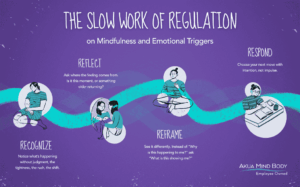
The nervous system doesn’t change through insight alone; it changes through repetition. Each mindful pause before reacting, each breath before speaking, is a quiet reminder from the mind to the body: we’re safe now. We need to understand that regulation isn’t about suppressing emotion; it’s about guiding it.
A process of teaching your body that not every rise in feeling requires defense and that intensity isn’t danger. The same awareness that steadies emotion can reshape how we relate to our body, from eating habits to rest.
It follows a simple rhythm, each step building on the last, guiding you from reaction to awareness:
- Recognize: Notice what’s happening without judgment, the tightness, the rush, the shift.
- Reflect: Ask where the feeling comes from. Is it this moment, or something older returning?
- Reframe: See it differently. Instead of “Why is this happening to me?” ask “What is this showing me?”
- Respond: Choose your next move with intention, not impulse.
This is slow work because every repetition retrains the nervous system, showing it that discomfort can coexist with safety. And yet, what happens when the emotion swells faster than awareness can follow?
When the Emotion Feels Too Big
There will be moments when awareness feels too small for what’s rising inside. When the mind floods faster than the breath can follow. Mindfulness doesn’t shrink those emotions; it helps you anchor within them. Grounding brings you back to now, the only place the nervous system can rest:
- Notice five things you can see.
- Touch four things near you.
- Listen for three distinct sounds.
- Name two things you can smell.
- Focus on one thing you can taste.
The R.A.I.N. method: Recognize, Allow, Investigate, Nurture, offers both structure and softness. You recognize the feeling, allow it to exist, investigate what it needs, and nurture yourself with kindness.
- Recognize what’s happening: Try naming what you feel, anger, sadness, fear, guilt, restlessness, whatever’s there. It helps bring the feeling into light, turning it from something overwhelming into something you can notice, hold, and breathe through.
- Allow it to exist: Let the feeling be there; you don’t have to rush to fix it or cover it with positivity. Just let it be. Allowing doesn’t mean you like it; it just means you’re brave enough to face it.
- Investigate with curiosity: Instead of asking “Why am I like this?” try “What is this feeling trying to tell me?” Maybe it wants rest, reassurance, or just a moment to be heard. You’re not solving a problem here, so stay curious, not critical.
- Nurture with kindness: This is where you turn softness into strength. Offer yourself the kind of care you’d give to someone you love, maybe it’s a slow breath, a comforting thought, or simply saying, “You’re okay. You’re trying.”
There are countless ways to begin, R.A.I.N., S.T.O.P., grounding, or simply pausing long enough to breathe. Each one brings you back to the same place, a quiet moment of reflection, where practice turns into awareness and awareness turns into understanding.
The Return Home
Whether you practice one, pair a few, or move between them over time, what matters isn’t the method; it’s the moment you recognize the need. The moment you choose to meet what’s rising instead of running from it. That’s really what mindfulness teaches, not how to escape emotion, but how to find your way back through it.
And when that safety feels distant, when you’re moving through recovery, grief, or the heavy work of mental health, guidance helps. AKUA’s mindful approach offers that kind of grounded companionship: gentle structure, real presence, and the reminder that coming home to yourself doesn’t have to be done alone.
Because “home” isn’t a place outside you, it’s the steady ground within. It’s the moment awareness catches up to emotion and says, ‘You’re okay, stay here.’ That’s what the work is really about. Not perfection. Not endless calm. Just the practice of remembering you can always return, to breath, to body, to yourself.
To Home…
You might also like

ESSENTIAL SERVICES
Reading Time: 2 MinutesThe COVID-19 crisis has obviously disrupted all aspects of life in America and around the world. All of us are individually and professionally impacted in dramatic ways. At AKUA Mind Body, we are grateful that our business is an “essential service” and blessed to have the opportunity to continue to help our clients. The current […]

California Native American Day: Understanding Substance Misuse Among the Indigenous Population
Reading Time: 4 Minutes“Protect our Elders, and they will pass their knowledge and wisdom to our Children. Protect our Women, and they will love, support, and educate our Children. Protect our Children, and they will continue to carry on Tribal traditions, customs, language, and help establish equality and justice for all Tribes”. – California Tribal Chairpersons Association (CTCA) […]

Am I Engaging in Self-Harm Behavior?
Reading Time: 3 MinutesSelf-harm, also known as intentional self-injury behavior, is the purposeful action of inflicting physical harm on your body and is a red flag sign for emotional distress. According to psychiatrists, self-harm is appropriately recognized as nonsuicidal self-injury disorder (NSSID) as these self-harm behaviors are done without any intention of suicide. In other words, the individual […]