

Mindfulness and the Brain: Benefits for Better Mental Health
Scientifically speaking, the brain is the body’s command center, a vast network of approximately 86 to 100 billion neurons, transmitting electrical and chemical signals that shape how we think, feel, and act. It isn’t static; it constantly adapts through neuroplasticity, rewiring itself based on what we repeatedly do or focus on.
Mindfulness for brain benefits lies in this very adaptability. The practice of paying purposeful, non-judgmental attention to the present moment directly influences how the brain rewires itself. Research shows that consistent mindfulness practice strengthens neural pathways related to focus and emotional regulation while calming overactive stress centers such as the amygdala.
Heavy right, that’s the science, but for us as human beings, what it means is, it is both a biological and existential reset, a reminder that beneath the noise of modern life, we still have the capacity to pause, choose, and fully experience the present. The pace of modern life, however, demands more from our brains than they were designed to handle.
What we call multitasking is actually a form of fragmentation characterized by a continuous stream of alerts and inputs that keep the nervous system on edge. Our brains evolved for survival, not constant stimulation. Mindfulness trains the brain to respond rather than react, reducing cortisol levels and enhancing clarity, balance, and resilience. Consider it a science-backed recalibration.
What once was ancient wisdom now stands validated. Neuroscientists can literally watch calm take shape in the brain by using neuroimaging techniques like functional magnetic resonance imaging (fMRI) and electroencephalography (EEG), confirming what monks understood intuitively: When we train awareness, we reshape ourselves neuron by neuron.
Somewhere between the lab and the quiet mind lies the real story of mindfulness, how awareness turns biology into balance.
The Path from Science to Self:
- An Overstimulated Brain
- Mindfulness for Brain Benefits
- Cortisol and Mental Health
- The Mindful Brain and Emotion
- Mindfulness in Everyday Life
- Finally, From Brain to Being
Before we uncover how mindfulness heals, we first need to see what the modern mind is up against, a brain caught in constant motion.
An Overstimulated Brain
The human brain, built for focus and pattern recognition, is instead forced into rapid-fire task switching, a phenomenon Dr. Sophie Leroy termed “attention residue,” the lingering cognitive cost of jumping between tasks without mental recovery. This constant dispersal of attention pulls neural focus away from sustained concentration, subtly activating the amygdala, the brain’s alarm center.
We’ve grown used to this rhythm, mistaking busyness for productivity while constant connectivity quietly corrodes attention. According to Reviews.org, the average American checks their phone 205 times a day, or almost once every five minutes while we’re awake.
Over time, this constant state of readiness floods the nervous system with cortisol, the stress hormone, keeping the body in low-grade survival mode. This constant cognitive strain is what researchers now describe as mental fatigue on a societal scale. In 2024, the Oxford Word of the Year, “brain rot,” gave this overstimulation a name.
Once a meme for endless scrolling, it’s now used by psychologists to describe the cognitive decline caused by low-quality digital consumption. So, when we talk about mindfulness for brain benefits, we look at it as a neurological correction, a way to reclaim the equilibrium that constant connectivity has eroded.
And this is where the science of mindfulness begins to meet the realities of the modern brain, offering restoration where overstimulation has taken hold.
Mindfulness for Brain Benefits
Jon Kabat-Zinn, founder of the Mindfulness-Based Stress Reduction (MBSR) program, words “the awareness that arises from paying attention, on purpose, in the present moment, and without judgment,” aptly capture the core of mindfulness, which isn’t about emptying the mind; it’s about training it to pay attention.
The power of mindfulness for brain benefits lies in its direct impact on how the brain functions, and even how it’s shaped. Way back in 2011, a Harvard Health article reported that regular mindfulness practice was associated with increased gray matter density in regions linked to memory, learning, and emotional regulation, a finding later echoed in subsequent research.
Meanwhile, research from Mount Sinai (2025) used intracranial EEG imaging to observe real-time changes in the amygdala and hippocampus, areas responsible for emotional control and memory, further underscoring how mindfulness strengthens emotional resilience, enhances focus, and reduces stress at a neurological level.
Key Benefits of Mindfulness for the Brain
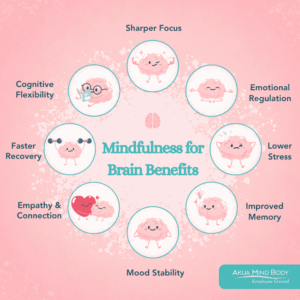
Scientific findings now link mindfulness practice to wide-ranging improvements in cognition, emotion, and stress recovery:
- Sharper focus and attention: Strengthens neural circuits responsible for sustained concentration.
- Enhanced emotional regulation: Calms overactive amygdala responses and improves recovery from stress.
- Improved working memory: Supports recall, learning, and decision-making clarity.
- Lower stress and anxiety: Reduces cortisol, balancing the mind–body connection.
- Mood stability: Promotes healthier neurotransmitter balance and emotional steadiness.
- Empathy and connection: Activates brain regions linked to compassion and perspective-taking.
- Cognitive flexibility: Strengthens neuroplasticity, the brain’s ability to adapt to change.
- Faster cognitive recovery: Helps the mind “reset” after overwhelm, improving resilience under pressure.
What Eastern traditions have long described as awareness, neuroscience now defines as integration, the coordination between the emotional brain and the rational mind. In Buddhist practice, Sati means observing without resistance; in yoga psychology, Pratyahara is the gentle withdrawal from overstimulation.
Both point to the same truth in the brain: the tender, reactive core where emotions rise, soften, and settle, what we call the limbic system, quiets through mindfulness in ways MRI scans can capture. Through mindfulness, the brain reestablishes dialogue between emotion and logic, body and thought, instinct and reflection.
Cortisol and Mental Health
When the brain perceives threat, whether from real danger or the constant strain of modern life, it triggers the hypothalamic-pituitary-adrenal (HPA) axis, releasing cortisol, the body’s primary stress hormone. In short bursts, cortisol sharpens focus and readies us for action. But when this system never shuts off, the same hormone that once protected us begins to dismantle clarity and calm from within.
Mindfulness helps recalibrate this stress loop by quieting the amygdala and reactivating the prefrontal cortex, teaching the body that not every signal is a crisis. This is why mindfulness-based therapies have become central to modern recovery programs. Organizations like Akua Mind Body integrate mindfulness with neuroscience and therapy to help individuals manage anxiety, trauma, and addiction, rebuilding safety and connection from within.
When awareness meets structured support, healing accelerates and the mind learns not just to cope, but to recover.
The Mindful Brain and Emotion
If the body’s stress system is the first to react, emotion is the next to follow as they are the body’s first responders, quick, instinctive, and deeply physical. They rise before reason, flooding the mind with signals meant to protect us. Mindfulness creates a pause in that pattern, a moment to notice rather than react. Each breath of awareness interrupts the automatic loop between feeling and response, giving the nervous system room to reset and the mind space to choose.
With practice, this awareness strengthens emotional resilience, helping calm become the brain’s natural state. Its effects ripple outward, subtle at first, then transformative across how we think, feel, and connect:
- The mind becomes less reactive, recovering more quickly after stress.
- Awareness deepens understanding of others.
- With space between feeling and action, choices become more grounded.
Mindfulness trains the emotional brain the way exercise conditions the body, through repetition and gentle awareness. Emotions still arise, joy, frustration, hope, fear, but they no longer dictate the rhythm of life. What changes isn’t the emotion itself, but our relationship to it. In that shift lies a quiet kind of freedom, not from emotion, but within it.
Mindfulness in Everyday Life
The real test of mindfulness unfolds in the noise of ordinary life. Between work, screens, and responsibility, stillness can feel impossible. Yet mindfulness doesn’t depend on silence; it depends on attention.
Here are small, practical ways to integrate mindfulness into daily living:
- The One-Minute Reset: Pause between tasks. Take one slow, conscious breath. Feel the rise and fall of your chest, the weight of your body, the space you occupy. That single minute signals safety to your nervous system and brings your mind back from autopilot to awareness.
- Mindful Transitions: Before a meeting, a commute, or a difficult conversation, stop for five steady breaths. These brief resets train your brain to shift gears smoothly, reducing the mental “carryover” stress that builds when we rush from one task to another without pause.
- The STOP Method: When you feel overwhelmed, try this simple four-step tool:
-
- S-Stop what you’re doing.
- T-Take a slow, deliberate breath.
- O-Observe your thoughts, sensations, and emotions without judgment.
- P-Proceed with awareness instead of impulse.
- Each time you practice, you strengthen the brain’s response flexibility, the ability to pause before reacting.
-
- Digital Mindfulness: Before you slip into another scroll, pause and ask yourself: Why now? Are you reaching for connection, distraction, or simply out of habit? That moment of awareness is where a digital detox truly begins.
Over time, this small act rewires the neural pathways that crave constant stimulation, restoring both focus and calm.
Finally, From Brain to Being
Yes, It begins in the brain, but its purpose reaches far beyond biology. What starts as neural rewiring becomes something deeply human, a way of living with awareness, empathy, and presence. Beneath every scientific finding lies something far simpler yet profound: the quiet capacity to meet life as it is, not as we fear or expect it to be.
In an age that rewards reaction, mindfulness teaches regulation, a balance between awareness and action. This is why mindfulness has become central not only in wellness but in mental health and addiction recovery, forming the foundation of programs at places like Akua Mind Body, where awareness is used to rebuild safety, stability, and connection from within.
In the end, mindfulness for brain benefits is only part of the story. Its deeper gift is wholeness, a mind that responds with clarity, a body that rests in balance, and a self that finally feels present in its own life.
You might also like

Honesty in Recovery
Reading Time: 3 MinutesSubstance use disorders, whether it is heroin, marijuana, alcohol, cocaine, or stimulants, no doubt, harvest secrecy, isolation, and deception. Individuals with a substance use disorder often live in a complex web of lies specifically designed to keep dangerous coping mechanisms in place and “protected” from those who sincerely want to help. Individuals will often hide […]

World Teen Mental Wellness Day
Reading Time: 4 MinutesLooking at the Relationship Between Opioid Misuse and Depression in Teenagers World Teen Mental Wellness Day is observed across the globe on March 2 every year. This day aims to raise awareness about mental health issues in teenagers. Mental health struggles are common in teens, making up 16% of diseases and injuries in people aged […]

AKUA Mind and Body – women’s residential treatment center has been ranked in the top seven in Newsweek’s 2021 list of the best addiction treatment centers in California
Reading Time: 2 MinutesThe entire team at AKUA Mind and Body is incredibly proud of how dedicated our staff works daily to provide the best treatment services possible for our clients and their families. In addition, we congratulate our fellow addiction treatment centers, who were also ranked in California’s top 80 treatment centers. AKUA Mind and Body-women’s residential […]