

Mindfulness for Productivity at Work Begins Where Busyness Ends
We talk about productivity like it’s the holy grail of modern work, the ultimate measure of success, stability, and growth. It powers promotions, fuels our ambition, and fills the quiet spaces between one deadline and the next. And to be fair, the drive to succeed isn’t wrong. There’s pride in discipline and dignity in working hard for the life we’re trying to build.
But don’t you think that somewhere in that pursuit, it’s also quietly costing us our peace of mind? Somewhere between being productive and being consumed by it, we cross a line, one that’s easy to miss until we’ve already lost sight of balance. That’s where mindfulness for productivity at work provides a sustainable way to protect focus, restore balance, and bring mental clarity into a world that rarely pauses.
We’ve built a culture where burnout feels normal and stillness feels suspicious. We say we’re fine, “just a bit tired,” but the headlines tell another story. The internet is flooded with accounts of professionals collapsing under invisible pressure, anxiety, exhaustion, work-related breakdowns, and even suicides that no KPI could predict or prevent.
Professionals, especially in places like California’s tech corridors or the corporate towers, are always on yet rarely present, and when you multiply that by deadlines, decisions, and digital distractions, it’s no wonder burnout has become one of the most common occupational hazards in the United States.
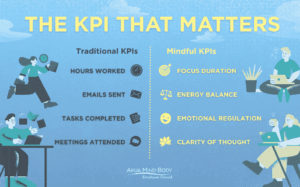
If productivity is the goal, awareness is the metric we’ve been missing. The new frontier of performance lies in something less visible: focus, presence, and the ability to sustain clarity in the middle of constant motion.
We take a look at the silent KPIs worth understanding and integrating, not the ones on your performance sheet, but the ones that keep your mind, energy, and purpose intact.
- What is Mindful Productivity
- What’s Silently Draining Your Productivity
- Mindfulness for Productivity at Work
- Digital Boundaries, Real Focus
- Mindful Communication
- The ‘Calm’ Advantage
What Is Mindful Productivity?
We may often think of mindfulness and productivity as opposites, as one evokes stillness, the other motion. But in truth, mindfulness for productivity at work isn’t about choosing between calm and achievement. It’s about learning to merge the two. Decades of research show that mindfulness strengthens both mental and physical well-being, improving sleep, lowering anxiety, and reducing stress-related illnesses.
Structured programs like Mindfulness-Based Stress Reduction (MBSR) and Mindfulness-Based Cognitive Therapy (MBCT) have proven effective not just in healthcare, but increasingly in leadership and workplace training across the U.S. To be mindfully productive means to be consciously present in what you’re doing, while you’re doing it.
It’s the art of staying connected to your task, aware of your emotions and thoughts, without letting them dictate your direction. Some of the simplest ways this shows up in daily work:
- Catching yourself before you rush into the next task on autopilot.
- Take a breath before replying to that stressful email.
- Allowing five quiet seconds to reset your attention between back-to-back meetings.
Mindful productivity is focused on motion, wherein you stop fighting distraction and start managing your attention with intention. But before we think ‘focus,’ we need to understand what’s quietly stealing it. The thousand tiny ‘drains’ we don’t even notice…
What’s Silently Draining Your Productivity
Let’s think about moments where you answer another email, update a spreadsheet, join one more meeting, all things that appear productive, but have you ever felt that silent agony of switching from one to another? Probably not, as we are on autopilot and don’t realize that they chip away at focus in small, invisible ways.
Today’s exhaustion isn’t just about hours worked; it’s about attention divided. According to a McKinsey Global Institute analysis, knowledge workers spend about 28% of their workweek reading or replying to emails and nearly 20% searching for internal information, a reminder that not all “busy” time is productive time.
While the report focuses on how technology and better systems can enhance performance, it leaves room for another question: how does this constant communication affect our focus and well-being? The American Psychological Association refers to this phenomenon as switching costs, the cognitive toll of shifting between tasks.
Every ping, every tab switch, every “quick check” burns energy that’s hard to recover, and not all are digital. Some are cultural or emotional as well:
- The Culture of Constant Availability: In many industries, being “always reachable” is seen as commitment. But it keeps the brain in a state of low-grade tension, never fully resting or recovering.
- Emotional Residue: The unresolved meeting, the feedback loop, the quiet frustration linger mentally long after the moment has passed, draining emotional energy.
- Decision Fatigue: We make far more micro-decisions than we notice, and that steady drain on attention is why decision fatigue shows up by afternoon, even when we haven’t done ‘hard’ work.
- The Myth of Multitasking: Recent research shows that multitasking, especially switching rapidly between tasks, leads to measurable drops in performance and slower task-switching. What feels efficient is often just accelerated distraction.
It’s important to understand that the mental weight of never really finishing anything, and not the workload, burns us out. Mindfulness doesn’t take that weight away; it only helps you see where your energy is leaking and teaches you how to reclaim it.
Mindfulness for Productivity at Work
You don’t need an hour-long meditation or a yoga mat tucked behind your desk. You just need small, deliberate pauses woven into the rhythm of your day, moments that remind your mind where it is before stress decides for you. And when you begin to approach work with that kind of awareness, these small, science-backed practices can turn even the busiest schedule into a calmer, clearer space to think.
- The Three-Minute Reset: Before the inbox takes over, take three minutes, no screens, no scrolling. Just breathe. Ask yourself: What do I want to bring into today, clarity or chaos? Three minutes won’t fix your workload, but it will change your relationship to it.
- The One-Task Rule: Every time you switch tasks, your brain burns glucose and oxygen. Try single-tasking as an act of respect for your time and your attention. When you write an email, just write the email. When you analyze data, close the extra tabs. You’ll finish faster and feel calmer, not because you did less, but because you did it fully.
- The 60-Second Reset Between Meetings: Take one minute to breathe deeply and relax your shoulders. Studies show that leaders who practiced mindful resets between meetings showed better decision-making and empathy.
Technology was meant to make our work easier, but somewhere along the way, it began to demand more from us than it ever gave back, the only way forward is to set some boundaries.
Digital Boundaries, Real Focus
We get it, it’s difficult to do without the tools we rely on to stay productive. But, how about, with mindfulness, we redefine the relationship we have with them, kind of shifting from passive consumption to intentional interaction. The goal here isn’t to disconnect, but to connect deliberately, choosing how and when our attention is spent.
Let’s begin with quiet, deliberate adjustments that allow space for focus to return.
- Turn off non-essential notifications for one focused hour each day. Give your brain permission to work without interruption and remember what sustained concentration feels like.
- Batch your email checks instead of constantly refreshing. Set specific times, once in the morning, once in the afternoon, and notice how much calmer you feel when you’re no longer reacting to every incoming message.
- Take one screen-free lunch, even once a day. Let your mind rest where your hands already are. Look outside, eat slowly, and let the world unfold without a filter for a moment.
By setting limits on how technology engages you, you begin to notice a quiet shift; you’re no longer pulled by every vibration or alert, but grounded in your own rhythm. And that same awareness, when brought into how you connect with others, becomes the heart of mindful communication.
Mindful Communication
Even with the best boundaries in place, the way we communicate can still make or break our sense of calm. The modern workday runs on conversations, and our instinct to respond often overtakes our ability to reflect. We reply fast, because fast feels productive. But sometimes, speed simply amplifies stress.
Engaging in mindful communication is noticing the tone behind your words, the emotion beneath your reaction, and the intention guiding your response. A single pause before hitting “send” can shift the entire energy of a conversation.
Try weaving mindfulness into the way you interact:
- Pause before replying: Take one full breath between the trigger and the response. That small gap can turn reaction into resolution.
- Listen completely: Stay with the words being said instead of preparing your answer mid-sentence. Attention itself is respect.
- Respond, don’t absorb: You can meet urgency without inheriting it. Calm, not speed, signals authority.
The truth is, communication itself is a form of stress, and not all stress is harmful. The Yerkes-Dodson Law reminds us that a moderate level of pressure can sharpen focus and improve performance, but once that pressure tips into overload, it backfires as clarity collapses, tempers rise, and words lose precision. Mindfulness helps you recognize that tipping point in real time, allowing you to pull back.
Being mindful and practicing mindfulness at work teaches you to speak from presence instead of pressure, to listen with empathy instead of anticipation. And in a workplace where everyone’s rushing to be heard, that kind of awareness gives you…
The Calm Advantage
We used to believe productivity was about doing more; now we know it’s about being more present in what we do. Mindfulness for productivity at work doesn’t demand silence or stillness; it invites awareness into motion. It’s how professionals learn to meet their day with clarity instead of chaos, and how organizations begin to value attention as much as action.
Because focus isn’t found in the absence of noise, it’s built in the middle of it. When you learn to work mindfully, you don’t just perform better. You feel better. And that’s the real metric worth measuring.
Logging off for now…
You might also like

Top Reddit Communities for Resources in Recovery
Reading Time: 4 MinutesProfessional therapy is the gold standard for addiction treatment and can give you the tools needed to ask the right questions and engage in social recovery communities. As you progress through rehab, it can be helpful to build a community of support from peers who have also experienced addiction and recovery. Social support, including online […]

Family Support System For Someone in Recovery
Reading Time: 4 MinutesCommitting to addiction treatment is a challenging, humbling, and commendable process that affects the individual with the substance use disorder, but it also affects their family members. Each family member who experiences their loved one struggling with addiction often endures many painful emotions, such as hopelessness in response to substance abuse. Family members may feel […]

Providing Inclusive Addiction Treatment to the LGBTQ Community
Reading Time: 3 MinutesHow does your sexual orientation contribute to your addiction? Are you comfortable in your own skin? Have you told anyone your sexual orientation? Do you have anyone in your life that supports your sexual orientation? Have you told anyone about your struggle with addiction? In the early those of addiction treatment, LGBTQ individuals need support, […]