

Mindfulness for Trauma Recovery and the Art of Feeling Safe Again
Trauma is far more common than most people realize. Across the United States, millions of adults have lived through experiences that overwhelmed their sense of safety and control. While not everyone develops post-traumatic stress disorder (PTSD), many continue to carry the emotional and physical imprints of what happened long after the danger has passed.
The word “trauma” makes many people uneasy, not because they’ve never experienced it, but because they have, and were taught to call it something else. We live in a culture that celebrates endurance and “moving on,” where pain is often dismissed as burnout, stress, or simply “life.” Yet what so many carry quietly in their bodies is not weakness or sensitivity, it’s trauma, unspoken and unresolved.
It can live in the constant tension of your shoulders, the flinch at a sudden sound, or the feeling that you’re “fine” but never truly at ease. For millions of Americans, trauma isn’t a single event to move past; it’s an ongoing experience quietly written into both body and mind.
Mindfulness for trauma recovery helps survivors rebuild safety in their bodies, notice emotions without being overwhelmed by them, and relate to their experiences with compassion rather than fear. As trauma educator David Treleaven, Ph.D., author of Trauma-Sensitive Mindfulness, explains:
“Mindfulness can be a profound support for trauma survivors, but only when practiced in a way that honors the body’s need for safety and control.”
With this piece, we take a closer look at what trauma really is, how it reshapes the brain and body, and how mindfulness, when practiced with care, can support recovery and resilience.
Exploring Mindfulness for Trauma Recovery
- Understanding Trauma: What Science Says
- Traumatic Events Adults Experience
- How Trauma Shapes the Mind and Body
- Why Mindfulness Matters in Trauma Recovery
- Core Principles of Trauma-Informed Mindfulness
- Grounding Techniques for Emotional Stability
- Cultivating Compassionate Self-Awareness
- Akua Mind Body: Where Healing Takes Root
Understanding Trauma: What Science Says
The American Psychological Association (APA) defines trauma as “an emotional response to a terrible event like an accident, rape, or natural disaster.” But psychologists and neuroscientists now agree that trauma is more than a story from the past; it’s a lived imprint that shapes how the body and mind respond to life in the present, and the definition barely captures its depth.
Trauma doesn’t have to begin with a single, catastrophic moment. It can unfold quietly through years of chronic stress, neglect, discrimination, or emotional strain. In clinical terms, trauma occurs when an experience overwhelms the brain and body’s ability to cope. It disrupts emotional balance, fragments memory, and can distort one’s sense of safety and connection.
Trauma expert Bessel van der Kolk, M.D., author of The Body Keeps the Score, captures this perfectly: “Trauma is not just an event that took place sometime in the past; it is also the imprint left by that experience on the mind, brain, and body…”
That imprint explains why trauma isn’t always visible. A combat veteran and a burned-out nurse may carry completely different memories yet share the same physiological patterns of hypervigilance and fatigue. A child who grew up unseen or constantly criticized may exhibit the same survival responses as someone who endured a serious accident.
Traumatic Events Adults Experience
For many, the word trauma evokes images of war, disaster, or tragedy, experiences so extreme they seem to happen to other people. What overwhelms one person’s ability to cope may not affect another in the same way.
- Physical or sexual assault.
- Serious accidents or medical emergencies.
- Domestic violence or chronic emotional abuse.
- The sudden or violent loss of a loved one.
- Combat exposure or war-zone experiences.
- Natural or human-caused disasters.
- Witnessing violence or death.
This list isn’t all-inclusive; trauma is deeply individual. For some, trauma may stem from moments that appear ordinary to others, a harsh word, an unexpected reminder, or even the daily weight of uncertainty. Regardless of the source, trauma leaves its mark not just emotionally, but physiologically.
How Trauma Shapes the Mind and Body
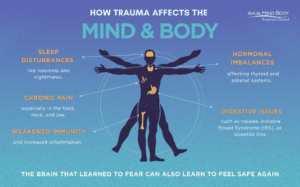
It all begins when the body senses danger; it activates the fight, flight, or freeze response, a flood of stress hormones designed to protect you. But when that response becomes chronic, the body forgets how to stand down, and the brain forgets what calm feels like.
Renowned psychiatrist Dr. Daniel Siegel describes the Window of Tolerance as the body’s natural zone of regulation, the range where we can think, feel, and respond without becoming overwhelmed. When we move outside that window, we tend to swing toward hyperarousal (panic, anxiety, anger) or hypoarousal (numbness, exhaustion, dissociation).
Physically, this dysregulation can manifest as:
- Sleep disturbances like insomnia and nightmares.
- Digestive issues such as nausea, Irritable Bowel Syndrome (IBS), or appetite loss.
- Chronic pain, especially in the back, neck, and jaw.
- Weakened immunity and increased inflammation.
- Hormonal imbalances affecting the thyroid and adrenal systems.
The good news, though, is that the same neuroplasticity that allows trauma to shape the brain also allows it to heal. With the right tools, especially mindfulness, the nervous system can relearn balance and safety.
Why Mindfulness Matters in Trauma Recovery
Mindfulness for trauma recovery helps bridge the gap between the mind’s awareness and the body’s experience. It teaches survivors how to safely witness their internal states without becoming overwhelmed by them.
Mindfulness pioneer Jon Kabat-Zinn, Ph.D., defines it as “the awareness that arises from paying attention, on purpose, in the present moment, and nonjudgmentally.” For trauma survivors, that awareness becomes a gateway to regulation. Studies show that mindfulness:
- Calms the amygdala, reducing emotional overactivation.
- Interrupts intrusive thoughts, helping the mind focus on the present.
- Activates the parasympathetic system, restoring “rest and digest” functions.
- Increases self-compassion, reducing shame and self-blame.
- Strengthens neuroplasticity, allowing the brain to build new, safer associations.
In advanced therapeutic environments such as Akua Mind Body, mindfulness is integrated into trauma-informed therapies like CBT, DBT, and EMDR. The goal isn’t to “empty the mind” but to build the capacity to notice, to pause before reacting, to feel before fleeing.
As David Treleaven reminds us: “Mindfulness doesn’t erase trauma, it changes our relationship to it.”
Core Principles of Trauma-Informed Mindfulness
Trauma-informed mindfulness rests on three pillars: safety, pacing, and choice. These create the foundation for mindful healing that doesn’t retraumatize.
Safety: Trauma often robs people of a sense of control. Mindfulness restores safety by offering autonomy: keeping eyes open during meditation, choosing whether to sit or move, or ending a session at any moment. Safety must always come first.
Pacing: Too much introspection, too soon, can overwhelm the nervous system. Trauma-informed practice moves slowly, one breath, one sensation, one moment at a time.
Choice: Choice counteracts the helplessness trauma creates. Choosing where to place attention, when to stop, and how to anchor oneself fosters empowerment.
According to Treleaven’s Five Principles, trauma-sensitive mindfulness should always honor:
- Safety first
- Autonomy and choice
- Trust in bodily signals
- Empowerment through agency
- Collaboration with support systems
So therapists tailor mindfulness exercises to each person’s tolerance. Some use sound as an anchor; others use movement or touch. What matters most is honoring the individual’s pace and capacity for awareness.
Grounding Techniques for Emotional Stability
Grounding isn’t about staying still; it’s about finding your way back when the body starts to drift into overwhelm. These trauma-sensitive mindfulness techniques help anchor the nervous system safely in the present, reminding the body that this moment is safe.
Orienting to Safety
When you feel untethered, pause and gently look around your space. Name three things you can see, two things you can hear, and one thing you can feel. This simple sensory exercise signals to the brain that you are here and now, not back in a moment of threat, a first step in easing hypervigilance.
Resourcing for Calm
Bring to mind a person, place, or memory that evokes calm, a quiet beach, a trusted friend, or even a beloved pet. Notice how safety feels in your body: the warmth in your chest, the softening of your shoulders, a steadier breath. Resourcing helps train your nervous system to access peace on demand.
Pendulation and Regulation
Pendulation is the gentle art of moving attention between tension and ease in the body, a mindful back-and-forth that helps you stay connected without becoming flooded. By noticing where the body feels tight, then shifting focus to where it feels calm, you gradually teach your system that it can handle both discomfort and relief.
Containment Visualization
When distressing thoughts or memories arise, imagine placing them in a mental container, a box, jar, or folder, that you can open later when you feel ready. This practice doesn’t suppress pain; it gives it boundaries, allowing you to acknowledge emotions without being consumed by them.
Tracking Sensation
Bring awareness to physical sensations, tingling, heaviness, warmth, and simply notice how they change over time. Tracking teaches the mind that sensations are temporary and safe to observe, helping the body relearn that movement and emotion can exist without danger.
Cultivating Compassionate Self-Awareness
Trauma often breeds quiet self-criticism, the thought, “I should be over this by now.” Mindfulness offers another way: meeting pain with gentleness instead of judgment. Research by Dr. Kristin Neff and Dr. Christopher Germer shows that mindful self-compassion lowers cortisol and activates the brain’s caregiving system, easing symptoms of PTSD and depression.
Begin simply:
- Notice sensations without labeling them “good” or “bad.”
- Replace self-criticism with curiosity, “What does my body need right now?”
- Place a hand over your heart and remind yourself, “I’m safe right now.”
Over time, this mindful self-acceptance helps the nervous system return to safety, reminding us that recovery isn’t about forgetting the past, but learning we can live peacefully with it.
Akua Mind Body: Where Healing Takes Root
Mindfulness becomes most powerful when it’s woven into a holistic treatment approach. When paired with evidence-based therapies such as CBT, DBT, or EMDR, it supports emotional regulation, enhances body awareness, and strengthens the mind’s capacity to stay present.
In trauma-informed programs practiced by Akua Mind Body, mindfulness is integrated with East meets West philosophies that address both the psychological and somatic aspects of trauma, helping individuals not suppress their emotions, but safely feel and process them.
When mindfulness and therapy work together, healing becomes sustainable, not a fleeting calm, but a gradual reclaiming of self. That, ultimately, is the heart of trauma recovery: not escaping the past, but reclaiming the present, fully, consciously, and with compassion.
In the end, mindfulness for trauma recovery boils down to the quiet, courageous art of feeling safe again.
You might also like

Substance Abuse is a Family Disease: How Does Substance Abuse Impact the Children?
Reading Time: 4 MinutesSubstance Abuse is a Family Disease: How Does Substance Abuse Impact the Children? One of the biggest misconceptions about substance abuse is that it only affects and hurts the person who is drinking or taking drugs. The fact is, the immediate family — predominately the spouse and children — is usually affected most. Substance Abuse […]

Sleep Awareness Week: Sleep and Mental Health
Reading Time: 3 MinutesSleep Awareness Week, March 13th-March 19th, 2022, aims to highlight the importance of good sleep and educate individuals about improving their sleeping habits. Founded by the National Sleep Foundation, Sleep Awareness Week provides individuals the opportunity to learn about why sleep is important, how good sleep can improve health, whether or not certain sleeping habits […]

World Bipolar Day: Common Misconceptions about Bipolar Disorder
Reading Time: 3 Minutes“At times, being bipolar can be an all-consuming challenge, requiring a lot of stamina and even more courage, so if you’re living with this illness and functioning at all, it’s something to be proud of, not ashamed of. They should issue medals along with the steady stream of medication.” -Carrie Fisher The hope and vision […]