

Mindfulness in America: The Quiet Revolution of an Ancient Practice
“The mind is everything. What you think, you become.”- Buddha
The ancients never called it “mindfulness.” To them, it was simply remembering, remembering to return, to notice, to inhabit this very breath. In Buddhist monasteries, monks trained their attention like artisans, shaping it with patience and compassion. In Hindu traditions, it was smriti, the sacred act of remembrance.
In Stoic philosophy, it was prosoche, the vigilant awareness of the present. Every culture, it seems, knew that the mind untended becomes a wanderer, and the wandering mind, a source of suffering. Now the hum of modern life rarely leaves room for remembering. We scroll, switch, and scatter ourselves thin across moments that pass before we can taste them.
Our nervous systems are constantly braced for the next alert, the next thought, the next thing. It’s no wonder we ache for calm, or mistake exhaustion for peace. That’s the paradox of modern living: connection everywhere, presence nowhere. And yet, here mindfulness returns as an ancient antidote. A homecoming to the present moment.
So what really is mindfulness? Where did it come from? And why, thousands of years later, does the world still circle back to this stillness in motion? Let’s dive in…
- East to West Journey of a Philosophy
- The Original Intention
- The American Mindfulness Movement
- ‘Mindfulness’ Applications in Health and Healing
- Mindfulness and Mental Health
- The Way Forward: Returning to Presence
East to West Journey of a Philosophy
The journey of mindfulness from ancient India to modern America reads like a cultural translation, part spiritual migration, part scientific rediscovery. In the late 19th and early 20th centuries, as Eastern philosophies began to reach Western audiences through scholars and travelers, the idea of meditation slowly entered psychological and philosophical discourse.
But it wasn’t until the 1960s countercultural wave, when young Americans disillusioned by war and consumerism turned eastward for meaning, that mindfulness began to take root in Western soil. Figures like Thich Nhat Hanh and the Dalai Lama became spiritual ambassadors of presence, while American practitioners such as Jack Kornfield, Sharon Salzberg, and Joseph Goldstein helped interpret these teachings for everyday American life.
Then, in 1979, Jon Kabat-Zinn, a molecular biologist at the University of Massachusetts, bridged the gap between ancient insight and modern medicine. He founded the Mindfulness-Based Stress Reduction (MBSR) program, introducing mindfulness as a secular, evidence-based method for managing chronic pain and anxiety.
What had once been a monastic discipline now entered hospitals and classrooms, framed in the language of science and psychology. As mindfulness found its way into therapy and research, one quiet question remained: could it still hold the same compassion it began with?
The Original Intention
It’s easy to forget that mindfulness has always been about living it rather than about mastery. It isn’t about silencing the mind or chasing calm, but about compassion and the quiet courage to stay. In Buddhist practice, mindfulness (sati) is inseparable from karuṇā, compassion. It was about meeting pain with gentleness, not to transcend it, but to notice and accept it without judgment, and stay present instead of running away.
This is what makes mindfulness not a technique, but a way of being. As modern life increasingly reduces mindfulness to a productivity hack or relaxation tool, remembering its origin as a path of liberation matters. True mindfulness doesn’t make you better at multitasking; it makes you better at being human.
And as America began to rediscover this centuries-old practice, something remarkable and complicated happened: mindfulness went mainstream, shaped by new cultures, new needs, and sometimes, new misunderstandings.
The American Mindfulness Movement
When mindfulness crossed the Pacific, yes, it did not arrive as incense and chants but as an idea: awareness as medicine. In America, that idea took on a life of its own; some embraced it as a genuine path to healing; others repackaged it into apps, workshops, and branded calm. Yet beneath all that noise, one truth remained unchanged: our collective longing for stillness in a world that never stops.
From Counterculture to Corporate Wellness
As the countercultural curiosity of the 1960s matured, mindfulness began finding unlikely homes in hospitals, universities, and even boardrooms. It started as a rebellion against excesses and quietly became a remedy within it, as even corporate America began to recognize the hidden cost of relentless striving.
Even the productivity-driven world, from Google to Goldman Sachs, has begun to pause, recognizing that performance without presence comes at a cost.
The Rise of “McMindfulness”
The rising popularity had its flipside, a quiet irony in the story of mindfulness. As it entered the mainstream, the practice that once invited depth was often simplified and reduced to a technique, stripped of its roots in compassion and ethics. This commercialization even earned a name: “McMindfulness,” a term coined by Buddhist psychotherapist Miles Neale and later popularized by scholar Ronald Purser.
It captured the growing unease around how a practice meant for liberation was being repackaged for productivity and profit. Apps, retreats, and merchandise promise peace for a price, sometimes missing the point entirely that mindfulness isn’t a product you buy, it’s a presence you cultivate.
Mindfulness That Matters
In all of this, authentic mindfulness initiatives across the U.S. are making quiet revolutions. Programs in schools teach children emotional regulation, prisons use mindfulness to reduce violence and recidivism, hospitals and mental health and addiction recovery centres apply it for trauma recovery and chronic pain.
We need to stop looking at mindfulness as a passing fad or a mere trend. It’s a testament to how awareness, when practiced sincerely, can reshape not just individuals but entire communities. As mindfulness settled into American life, it began to take on new shapes, as therapy, as treatment, as quiet intervention.
No longer a practice reserved for seekers or monks, mindfulness became a shared language of healing, meeting people where they hurt, where they heal, and where they begin again. From philosophy to clinical science, it didn’t lose its soul; it simply learned new ways to speak.
‘Mindfulness’ Applications in Health and Healing
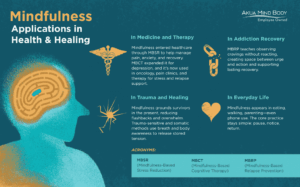
Once viewed as a cultural curiosity, mindfulness gradually earned recognition as a credible clinical tool. It continued to evolve, reshaped by therapists, neuroscientists, and wellness practitioners who recognized its quiet power in action. Today, it has become one of the most adaptable therapies of our time, merging ancient insight with evidence-based care, something Akua has long been known for.
What was considered a spiritual practice is now probably one of the most versatile tools in modern health and healing.
In Medicine and Therapy
The medical world embraced mindfulness not as mysticism but as a method. Jon Kabat-Zinn’s MBSR program brought meditation into hospitals, helping patients manage chronic pain, anxiety, and recovery. Soon after, Mindfulness-Based Cognitive Therapy (MBCT) adapted it for depression prevention, while clinicians began using mindfulness in oncology, pain clinics, and psychotherapy to help patients cope with stress, trauma, and relapse.
In Trauma and Healing
For those living with trauma, mindfulness offers something medication alone often can’t, safety in the present moment. By tuning into breath and body, survivors learn to anchor awareness in the “now,” reducing flashbacks and emotional flooding. Programs like Trauma-Sensitive Mindfulness (TSM) and Somatic Experiencing build on this principle, helping the body release what the mind can’t yet articulate.
In Addiction Recovery
Mindfulness doesn’t fight cravings; it watches them. Practices like Mindfulness-Based Relapse Prevention (MBRP) teach individuals in addiction recovery programs to notice urges with curiosity instead of resistance, allowing space between impulse and action. It’s not about suppression, but observation, a simple shift that can change everything.
In Everyday Life
It shows up in mindful eating, parenting, walking, and even how we scroll our phones. The practice remains the same: pause, notice, return. Because awareness, it turns out, is portable. But beyond its clinical and therapeutic value, mindfulness holds something more intimate, an inward turn that touches the heart of awareness itself.
Mindfulness and Mental Health
Mindfulness has become a quiet revolution in mental health, an anchor in a world that rarely pauses. In therapy, it offers a way to meet pain without drowning in it, to observe thoughts and emotions with gentleness rather than judgment. Yet its impact extends far beyond the mind. Regular mindfulness practice has been shown to lower blood pressure, regulate heart rate, and improve sleep, giving the nervous system space to recover from chronic stress.
Inside the brain, mindfulness doesn’t just soothe, it rewires. MRI studies reveal strengthened activity in regions tied to empathy, focus, and memory, and a calmer response from the amygdala, the brain’s fear and alarm center. This process, known as neuroplasticity, supports what ancient traditions long suggested: the mind is not fixed; it can heal, reshape, and restore itself.
Each moment of awareness initiates subtle biological shifts: the heart slows, the breath steadies, neural pathways strengthen. Mindfulness reminds us that recovery isn’t only about changing what we think, but retraining the body and brain to feel safe again.
The Way Forward: Returning to Presence
“In the end, just three things matter: how well we have lived, how well we have loved, and how well we have learned to let go.”- Jack Kornfield
We began with silence, and perhaps that’s where we return. Mindfulness, at its essence, is not a trend or therapy; it’s a remembering. A reminder that peace isn’t found by escaping the storm, but by learning to stand calmly within it. Healing through mindfulness begins as an inner act, one person slowing down, breathing deeper, noticing with kindness, yet its effects ripple outward. Many therapeutic spaces are rediscovering the truth that awareness itself can be medicine.
At Akua Mind & Body, this is where philosophy meets practice. Mindfulness is not an add-on, but a foundation, woven into therapy, trauma recovery, and holistic treatment to help individuals find safety within themselves again. Through awareness, clients learn to meet pain with presence and rebuild trust in their own bodies and minds.
In a world that rewards urgency, choosing stillness is a radical act. To pause, breathe, and just be, even for a moment, is to remember that we are human first, performers second. The story of mindfulness is really the story of return, from distraction to attention, from chaos to clarity, from fear to compassion.
It’s ancient, yes, but never more relevant. Because beneath all our data, diagnoses, and distractions lies a simple truth: we have forgotten how to be here.
And so, the quiet revolution continues, one breath, one moment, one remembering…
You might also like

Addiction to Cell Phones
Reading Time: 2 MinutesOver the years, advanced technological innovations have brought about major changes in the field of communication. With the advancement of internet, cell phones, and other electronic gadgets, the lives of people have substantially changed. Although the changes have brought positive outcomes to our lives, an addiction to cell phones has developed. This is demonstrated by […]

Mentorship in Addiction Recovery
Reading Time: 3 MinutesMentorships come in all shapes and sizes, from mentorships in the career and education space to mentorships in sports and the outdoors community; mentorships can be informal or formal. Mentorship in addiction recovery provides a structured accountability system between two individuals who can support each other and provide guidance to help teach and meet each […]
EMDR as Trauma Therapy
Reading Time: 2 Minutes“There are wounds that never show on the body that are deeper and more hurtful than anything that bleeds.” – Laurell K. Hamilton Trauma is an innate response to an alarming event that overwhelms an individual’s ability to cope, causes feelings of helplessness, and diminishes their sense of self and their ability to feel the […]