
Care That Learns to Listen: Building Trust Through Telehealth for Veterans and First Responders
“There is no greater agony than bearing an untold story inside you.” – Maya Angelou
They live beneath uniforms, badges, and an expectation of composure that rarely leaves room for vulnerability. They show up in disrupted sleep, emotional withdrawal, hypervigilance, strained relationships, or a growing reliance on substances to cope. These are not personal failures or isolated struggles but common responses to repeated exposure to trauma, high-stakes decision-making, and the constant demand to remain calm in the face of chaos.
From the earliest days of training, strength is all about control, reliability, and emotional restraint. And admitting distress can feel like risking credibility, professional standing, or the trust of a team that depends on you when lives are on the line. Layer in long-standing stigma, concerns about confidentiality, and fears of career repercussions, and then silence becomes a form of self-preservation.
The need for care is undeniable. In FY 2025 alone, more than 2.1 million veterans received mental health support through 11.7 million video-to-home visits, reflecting not just demand, but a shift in how and where care is finally reaching those who serve. The numbers tell a larger story: when access aligns with reality, veterans are far more likely to engage.
The challenge lies not in resilience, but in systems that too often require veterans and first responders to step away from their routines, responsibilities, and sense of control just to ask for help. The gap between need and access is where telehealth has begun to fundamentally change the conversation.
What telehealth looks like for those who serve:
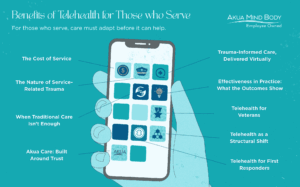
- The Cost of Service
- The Nature of Service-Related Trauma
- When Traditional Care Isn’t Enough
- Telehealth as a Structural Shift
- Trauma-Informed Care, Delivered Virtually
- Effectiveness in Practice: What the Outcomes Show
- Telehealth for Veterans
- Telehealth for First Responders
- Akua Care: Built Around Trust
The Cost of Service
For much of U.S. history, the psychological impact of service was not recognized as a legitimate medical need. During World War I, soldiers experiencing what was then called “shell shock” were often institutionalized or encouraged to suppress their symptoms. Emotional endurance was treated as a professional obligation rather than a human limit, and psychological distress was framed as weakness instead of injury.
A gradual shift began as veterans and advocates made silence untenable. The passage of the National Mental Health Act of 1946 marked a critical turning point, formally acknowledging that psychiatric injuries were real, widespread, and deserving of treatment. This recognition was not merely academic; it was shaped by the lived experiences of returning service members whose struggles exposed the long-term consequences of war.
First responders have followed a similar trajectory. Their work environments are defined by repeated exposure to crisis, loss, and moral injury. Yet professional culture has continued to reward composure, self-reliance, and emotional restraint, reinforcing the idea that managing distress privately is part of the job. What has evolved over time is not the presence of trauma, but a growing awareness that traditional models of care were never designed around the realities of service-based lives.
The Nature of Service-Related Trauma
Mental health challenges among veterans and first responders rarely originate from a single defining event. More often, they develop cumulatively, influenced by years of constant readiness, decision-making, and repeated exposure to danger. For veterans, the transition from structured military life to civilian environments can be particularly destabilizing. Service provides identity, routine, and a clear sense of purpose.
When that structure disappears, it is frequently replaced by isolation, uncertainty, and difficulty reintegrating. Conditions such as PTSD, depression, anxiety, sleep disorders, disruptions in eating habits, and substance use concerns may emerge months or even years after active duty has ended.
First responders experience a different timeline but carry similar psychological weight. A single shift may involve fatalities, violence, and ethical dilemmas that linger long after the scene is cleared. Over time, this accumulation erodes resilience, even among highly trained and experienced professionals.
Despite increased awareness and evolving public dialogue, many veterans and first responders continue to face barriers to care that feel accessible, confidential, and culturally aligned. Understanding the nature of service-related trauma is essential to recognizing why new approaches to mental health care, ones that meet individuals where they are, have become not just beneficial but necessary.
When Traditional Care Isn’t Enough
Traditional mental health care in the U.S. was built around predictability: office hours, in-person appointments, consistent availability, and the assumption that people seeking help can easily step away from their lives to receive it. For veterans and first responders, this model often breaks down before treatment even begins.
With large systems, veterans frequently encounter long wait times, geographic barriers, and fragmented continuity of care. First responders face rigid schedules, rotating shifts, and concerns about confidentiality and career impact. In both cases, the issue is not a lack of evidence-based treatment, but the format through which it is delivered.
Common barriers include:
- Scheduling conflicts due to unpredictable or overnight work
- Travel requirements, especially in rural or underserved areas
- Fear of stigma or professional consequences
- Cultural disconnect with providers unfamiliar with service-related trauma
When care requires people to rearrange their lives, explain their absence, or push past discomfort just to show up, many never make it through the door. This is where telehealth begins to matter, as a shift in how access is defined, one that meets veterans and first responders within the realities of their lives, rather than asking them to step outside of them first.
Telehealth as a Structural Shift
Telehealth introduces flexibility where rigid frameworks once stalled progress. Care no longer depends on proximity, fixed schedules, or predictable availability. It adapts to lives shaped by deployments, rotating shifts, and responsibilities that cannot be easily set aside. By lowering practical barriers, telehealth makes consistency possible.
It supports continuity of care and preserves discretion, allowing veterans and first responders to engage without disrupting the lives they’re already managing. At a structural level, virtual care changes access in several important ways:
- Care is no longer limited by geography or transportation, making support reachable regardless of location or mobility.
- Flexible scheduling supports consistency, reducing gaps in care caused by shift work, deployments, or overtime.
- Earlier intervention becomes possible, allowing support to begin before symptoms escalate into crisis.
Organizations like Akua integrate telehealth as part of a broader continuum of care rather than treating it as a standalone service. This means access to trauma-informed clinicians who understand service-related stressors and can maintain continuity even as circumstances change.
Trauma-Informed Care, Delivered Virtually
Trauma-informed care begins with an understanding that trauma reshapes how people experience safety, control, and trust. Veterans often carry trauma tied to combat, complicated by moral injury or losses that were never fully processed. First responders experience it differently, less as a single defining event and more as a slow accumulation, shaped by one crisis after another.
Telehealth supports trauma-informed principles by restoring a sense of agency. Clients retain control over their environment, their pacing, and the level of vulnerability they’re ready for. For individuals whose trauma involved constant vigilance or loss of control, that autonomy matters.
Over time, certain themes tend to surface in virtual sessions:
- Guilt and shame are tied to survival
- Grief over the loss of people, purpose, or identity
- Substance use is normalized within service culture
- Triggers related to sound, authority, or sudden stress
- Difficulty with emotional regulation and communication
The therapeutic work itself remains grounded in evidence-based care. Sessions may focus on reshaping unhelpful thought patterns (Cognitive Behavioral Therapy, Cognitive Processing Therapy), processing traumatic memories (Prolonged Exposure, EMDR), or building skills to tolerate distress and regulate emotions (Acceptance and Commitment Therapy, DBT-informed approaches).
These methods translate effectively to virtual settings because the foundation of the work does not change. What does change is access. And when access improves, an important question follows: Does care delivered this way actually lead to better outcomes?
Effectiveness in Practice: What the Outcomes Show
Telehealth’s effectiveness is best understood over time. Not in how quickly someone can book an appointment, but in whether care remains accessible, whether people stay engaged, and whether risk is reduced before crisis takes hold. For veterans and first responders, success looks different from what it does in the general population.
Here, effectiveness is measured by continuity, trust, and the ability to seek help without adding another layer of stress. Increasingly, outcomes suggest that virtual care delivers on all three, especially when access aligns with real life.
Telehealth for Veterans
Within the VA, telehealth has become part of how care actually happens. It grew out of necessity. Geographic dispersion, rising mental health needs, and long-standing access challenges demanded a different approach. By FY 2025, more than 2.9 million veterans participated in over 14.6 million telehealth encounters. More important than volume, however, is what happens after engagement begins.
Veterans receiving care through telehealth show greater clinical stability over time, including:
- Fewer hospital admissions and shorter inpatient stays, linked to remote patient monitoring programs serving more than 132,000 veterans annually
- Comparable outcomes for PTSD and depression, on par with in-person care
- Reduced crisis-level emergency visits, particularly among veterans with telehealth access
- High satisfaction and trust, with more than 90% reporting confidence in virtual care
These outcomes point to sustained engagement. Veterans are not just accessing care; they are staying with it.
Telehealth for First Responders
Mental health care for first responders is less centralized, but the pattern that emerges is consistent. Telehealth tends to be most effective where traditional models create the most friction. Effectiveness shows up less in volume and more in fit:
- Privacy lowers resistance, allowing care to happen without visibility or scrutiny
- Flexible scheduling supports consistency, adapting to rotating shifts and on-call demands
- Crisis support becomes more immediate, with telehealth-enabled consultation aiding de-escalation
- Reduced wait times, particularly in emergency and triage settings
Across both groups, the takeaway is similar. When care adapts to real lives, engagement improves. And when engagement improves, outcomes follow. That connection leads directly to the next question: how trust, privacy, and confidentiality shape whether care is even possible.
Akua Care: Built Around Trust
Stigma thrives in visibility and silence. Telehealth reduces both. By allowing veterans and first responders to seek care privately, it lowers resistance and makes the first step more achievable. Over time, care stops feeling like a last resort and becomes part of maintaining readiness, health, and long-term stability.
This shift matters for those who have spent their lives showing up for others, often without pause or recognition. Veterans and first responders are trained to absorb pressure and move toward risk. Mental health care that truly supports them must honor that reality by removing obstacles, not creating new ones.
At Akua, care is built around trust. Whether delivered virtually or in person, confidentiality is foundational. Privacy, discretion, and clinical integrity remain consistent across settings, allowing individuals to engage without fear of exposure or professional consequence. As Akua expands its telehealth capabilities, including the launch of a dedicated virtual care platform, the focus remains the same: extending access while preserving dignity.
For those who have served and carried the weight quietly, care that listens and adapts is here.
You might also like

7 Ways To Get More Out of Your Therapy Sessions
Reading Time: < 1 MinutesTherapy can be a powerful tool to help individuals overcome life’s challenges and improve their mental health. However, to make the most out of therapy sessions, it is essential to keep a few things in mind. While finding the right therapist is critical, it’s equally important to develop a trusting relationship with them, stay focused […]

Link Between Emotional Health and Mental Health
Reading Time: 4 MinutesA 4-Part Series throughout Mental Health Awareness Month Part 2: The Relationships between Mental Health and Emotional Health As we dive deeper into May and reflect on Mental Health Awareness Month, it is essential to recognize that mental health does not just encompass mental health disorders but includes the well-being of our emotional health. Mental […]

Set a Sober Routine for the Holidays
Reading Time: 3 MinutesI’m Not Drinking This Holiday Season. Why Can’t We Just Say It? It can be pretty unsettling to think about declining alcohol in an environment conducive to alcohol. Alcohol flows freely during the holidays, whether at holiday parties, around the dinner table, or during meal preparation. Many questions arise during the holidays and make us […]