

Not Leaving You High and Dry: Alumni Programs and Aftercare in Behavioral Health
Dare we say there is a quiet dread that can surface for some people when the door closes behind you, and there is no schedule telling you where to be next. No group waiting. No staff checking in. Just a parking lot, a phone in your hand, and the weight of real life rushing back in. You have completed treatment, but the world does not slow down to meet you there.
There is often a tinge of fear mixed with relief, and a bit of pride after waiting long enough for the moment. The expectation is subtle but powerful: you are “done,” and now you should be able to carry recovery forward on your own. Completing treatment is a significant milestone. It often brings a sense of relief, pride, and readiness to move forward. At the same time, it can introduce uncertainty. Support that continues beyond treatment matters in this space, because recovery doesn’t end at discharge.
The structure that once guided daily routines, scheduled groups, regular check-ins, and consistent support suddenly falls away. Life resumes quickly, and recovery must now exist within everyday responsibilities. This transition can feel disorienting. The experience of being left, figuratively speaking, high and dry after treatment is not new.
Long before modern behavioral health systems existed, early recovery movements recognized that healing did not hold without continuity. One of the earliest and most influential responses to this gap came from Alcoholics Anonymous, which introduced a model centered on ongoing peer connection rather than time-limited intervention.
While it was not a clinical alumni or aftercare program in the modern sense, it established a foundational principle that continues to shape recovery today: long-term healing is strengthened through continued community. Alumni programs and aftercare emerged from the same need for continuity.
These programs were not designed to extend treatment indefinitely or to suggest that recovery had fallen short. Instead, they exist to bridge the space between structured care and real life, ensuring that people are not left to manage recovery alone once formal treatment ends.
Recovery doesn’t stop when treatment ends; support shouldn’t either. Here’s what we cover:
- What Happens After Formal Treatment Ends
- Understanding Alumni and Aftercare Programs
- Why Ongoing Connection Matters in Mental Health Recovery
- Shared Experience Creates Lasting Strength
- Staying Connected with Akua
What Happens After Formal Treatment Ends
Life after formal treatment is often when structure changes, and support still matters. After discharge, the daily grind begins again. Work resumes. Family responsibilities return. Financial pressures reappear. Recovery continues, but now it must exist alongside everyday life rather than within structured care.
Recovery following treatment involves learning how to respond when routines change, stressors increase, and support is no longer built into each day. Without intentional aftercare, this stage can feel isolating, even for individuals who made meaningful progress during treatment.
Common experiences during this transition include:
- Feeling less grounded without regular clinical contact
- Difficulty applying coping strategies consistently
- Uncertainty about seeking continued support
- Pressure to appear “better” to others
- Increased isolation
- Not knowing who to reach out to when challenges arise
These experiences are not regressive. They are part of recovery, adjusting to a new phase. Alumni and aftercare programs recognize this moment, reinforcing that recovery continues beyond discharge and that staying connected still matters.
Understanding Alumni and Aftercare Programs
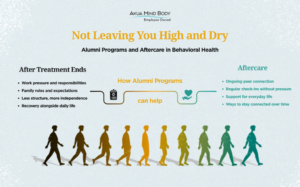
Staying connected doesn’t mean staying in treatment, and the word alumni carries a sense of continued belonging. In behavioral health, it reflects the idea that connection does not abruptly end once treatment concludes. Aftercare, by definition, refers to the support that follows primary care. In mental health settings, this typically means guidance and community that remain accessible after inpatient, residential, or intensive outpatient programs have ended.
Alumni and aftercare programs are designed to maintain connection without extending treatment indefinitely. They are not therapy and do not replace clinical care. Instead, they provide structured, non-clinical support that bridges treatment and long-term independence. Their purpose is not to continue intervention, but to provide continuity during a period when structure has been reduced, and personal responsibility has increased.
This distinction matters. Remaining connected is not the same as remaining in treatment, as aftercare isn’t treatment; it’s continuity. In behavioral health settings, aftercare support extends beyond clinical sessions and into everyday life. It provides connection without monitoring and guidance without formal intervention.
These programs may include:
- Peer-based connection spaces
- Community activities
- Access to guidance when challenges arise
- Flexible engagement options
Alumni and aftercare programs help ensure that the connection does not disappear once formal treatment ends. They provide a bridge, not an extension of clinical care.
Why Ongoing Connection Matters in Mental Health Recovery
Recovery thrives in community, yet one of the less talked about challenges after treatment is how quickly isolation can set in. Life resumes its pace. Responsibilities return. External expectations rise. Even individuals who made meaningful progress in structured care can find themselves navigating this phase more quietly than they expected.
Social connection is a key protective factor in mental health recovery. Periods of transition are when individuals are most vulnerable to isolation. Alumni and aftercare programs help normalize recovery as part of daily life through accessible engagement opportunities.
In many alumni and aftercare communities, it shows up in simple, low-pressure ways:
- Creative and expressive spaces where individuals can engage without needing to explain where they are in recovery.
- Shared activities and informal gatherings that foster familiarity without pressure to disclose.
- Workshops centered on everyday life skills such as routines, work readiness, or decision-making.
- Peer environments are built on mutual understanding rather than structured therapy.
- Digital touchpoints that allow connection to remain accessible within existing schedules.
- Opportunities to support others through mentorship, reinforcing confidence, and accountability.
Connection doesn’t need to be clinical to be powerful, and ongoing connection provides a steady presence during this phase. Knowing there is a place to return to, or a group that understands the experience, eases the pressure of managing recovery alone. It restores what is often lost after discharge: regular contact, shared understanding, and a sense of belonging.
Shared Experience Creates Lasting Strength
It feels different to be supported by people who have lived through similar experiences. Peer support in recovery is grounded in recognition. There is less need to explain the terrain, because others already understand it. That shared understanding reduces pressure and makes the connection feel more honest.
Peer support offers shared understanding, accountability, and encouragement. Being supported by others with lived experience reduces stigma and reinforces recovery through connection rather than oversight. Peers recognize patterns that feel familiar. They understand the tension between wanting independence and still needing support.
In alumni and aftercare spaces, accountability develops through familiarity and presence rather than enforcement.
Accountability grows through relationships, not oversight, which is why a difficult week, a lapse in routine, or the return of old thought patterns does not automatically signal failure. Within peer-supported spaces, these experiences are understood as part of recovery’s ongoing process rather than evidence that something has gone wrong.
Programs like those offered through Akua Mind Body reflect this approach by creating multiple peer pathways rather than a single track. Alumni may connect through regular group spaces, mentorship, identity-based communities, volunteer or service opportunities, and shared sober activities that support recovery through presence and participation.
Peer support keeps recovery anchored in real relationships. It offers accountability without judgment and understanding without explanation, creating steadiness that can carry individuals forward long after treatment concludes.
Staying Connected With Akua
Extended care programs at Akua Mind Body illustrate how continuity can be supported without extending treatment. Practical support, such as life skills guidance and short-term sober living options help alumni remain connected while reintegrating into daily life. Akua Mind Body offers alumni and aftercare programs that support recovery beyond treatment while respecting independence.
These include peer-led groups, life skills resources, digital tools, and flexible engagement options that allow individuals to engage on their own terms. Connection is designed to remain accessible rather than intrusive. Individuals can lean in during more challenging periods and step back when stability increases, without losing access to support altogether.
You don’t have to walk the next chapter alone. Recovery is not something you finish. It evolves as life changes. The person someone becomes a year after treatment will not face the same challenges as they might five years later. That evolution does not signal regression. It reflects growth. Alumni and aftercare programs provide continuity, connection, and reassurance that support remains accessible whenever it is needed.
Alumni and aftercare support are not about oversight or prolonging treatment. They exist so that support remains within reach, whether to reconnect, recalibrate, or simply remember that no one has to navigate recovery alone.
Stay connected. Keep moving forward.
You might also like

Procrastination and Mental Health
Reading Time: 4 MinutesPressing “snooze” on the alarm four times in a row, waiting until the last minute to finish a work deadline, rushing to school to make it on time, delaying paying bills until the due date; are you guilty of these? Certain activities are just more challenging to complete than others. After all, filing your income […]
Alcoholic Liver Cirrhosis: Strictly An Alcohol-Driven Health Complication
Reading Time: 3 MinutesNearly two-thirds of the U.S. population drinks alcohol regularly, and, consequently, four million adults are identified as having some form of liver disease, as stated by the Centers for Disease Control and Prevention (CDC). Liver disease is one of the most prevailing and remarkably responsible factors for morbidity and mortality due to alcohol, yet it […]

How Stigmatizing Language in the Mental Health and Addiction Treatment World Affects Treatment
Reading Time: 3 MinutesLanguage matters, especially when it comes time to mental health and addiction. Fortunately, how we view mental health and addiction has improved dramatically over the past few decades, and even in recent years, we still have a long way to go. For example, many generations have grown up in a society where stigmatizing words such […]