

Outpatient Addiction Treatment: Understanding Its Role in Recovery and Ongoing Care
Addiction treatment is not determined by preference or convenience, but by clinical acuity, with levels of care structured to match the severity of need and required support at a given point in time. Outpatient treatment operates at a lower level of clinical intensity than inpatient or residential care and is appropriate for individuals who are more stable or at lower acuity.
Within this framework, the effectiveness of outpatient care is determined by how well it aligns with an individual’s clinical needs, level of stability, and capacity for engagement. For instance, an individual who is medically stable and able to participate consistently in treatment may benefit from outpatient care, whereas those requiring closer monitoring or stabilization may need a higher level of support.
Clinical guidelines in the United States emphasize that treatment matching is more important than intensity alone. Determining the appropriate level of care is based on a clinical assessment of severity, risk, and the level of support required, rather than a fixed approach. In this context, outpatient treatment represents a clinically appropriate level of care that emphasizes continuity, real-world application, and sustained engagement over time.
This becomes more apparent when looking at how outpatient care unfolds in practice.
- What Outpatient Treatment Actually Looks Like
- Why Real-World Exposure Can Strengthen Recovery
- Flexibility, Accountability, and Daily Life Integration
- The Challenges of Outpatient Treatment
- Who Outpatient Treatment Works Best For
- Recovery and Support with Akua
What Outpatient Treatment Actually Looks Like
Outpatient treatment operates across a spectrum of care levels, typically including standard outpatient programs (OP), intensive outpatient programs (IOP), and partial hospitalization programs (PHP). Each level varies in frequency and duration of sessions, but all are designed to provide structured therapeutic support while allowing individuals to remain in their home environment.
A typical outpatient treatment plan may include a combination of:
- Individual psychotherapy focused on substance use patterns, co-occurring mental health conditions, and behavioral change
- Group therapy that supports peer interaction, shared accountability, and social learning
- Psychoeducation on relapse prevention, emotional regulation, and coping strategies
- Family involvement, when appropriate, to address relational dynamics and support systems
- Ongoing assessment and treatment planning based on progress and clinical response
Sessions are scheduled throughout the week, depending on the level of care. Higher-intensity programs such as partial hospitalization (PHP) often involve around 6 hours of treatment per day across most days of the week (approximately 36 hours weekly), while intensive outpatient programs (IOP) typically require a few hours per day for 3–5 days each week (approximately 9–15 hours weekly).
Standard outpatient care involves fewer, more flexible sessions. This allows for continuity of care without requiring a complete disruption of daily responsibilities, making it possible to integrate treatment into existing routines.
Why Real-World Exposure Can Strengthen Recovery
One of the defining features of outpatient treatment is that it takes place alongside everyday life rather than outside of it. From a clinical perspective, this can support the application of therapeutic interventions within the same environment where substance use behaviors have developed.
Behavioral change is more likely to be sustained when new coping strategies are practiced in real-world contexts. For example, individuals can apply skills related to craving management, stress response, and interpersonal communication in situations that naturally arise, rather than in simulated or controlled settings.
This exposure provides ongoing feedback that can be addressed in subsequent therapy sessions. Challenges encountered between sessions are not viewed as failures, but as clinically relevant data that inform treatment adjustments. Over time, this process supports the development of adaptive behaviors that are directly linked to the individual’s environment and daily experiences.
While this approach may introduce variability and unpredictability, it also increases the likelihood that progress made in treatment will translate into long-term behavioral change.
Flexibility, Accountability, and Daily Life Integration
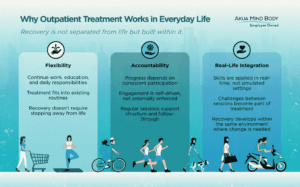
Outpatient treatment is structured to allow individuals to maintain their roles and responsibilities while engaging in care. This includes continuing employment, education, and family obligations, all of which can contribute to a sense of stability and purpose during recovery.
At the same time, this flexibility introduces a higher degree of personal responsibility. Attendance, participation, and follow-through are not externally enforced to the same extent as in residential settings, which means that treatment outcomes are closely tied to the individual’s level of engagement.
Clinical evidence suggests that retention in treatment and consistency of participation are key predictors of positive outcomes. This emphasis on continuity often extends beyond structured sessions. Many outpatient programs incorporate aftercare planning and alumni support networks, allowing individuals to remain connected to care even after formal treatment phases conclude.
These ongoing connections can reinforce accountability, provide peer support, and help sustain engagement during periods when motivation may fluctuate. Outpatient programs are therefore designed to support accountability through regular scheduling, progress monitoring, and therapeutic relationships that reinforce commitment to the process.
By integrating recovery into daily life rather than separating it, outpatient care supports the gradual development of routines and behaviors that can be maintained beyond the treatment period.
The Challenges of Outpatient Treatment
Despite its advantages, outpatient treatment presents specific challenges that need to be considered when determining appropriateness. The absence of a controlled environment means that individuals remain exposed to triggers, stressors, and social contexts associated with substance use, which can increase the risk of relapse, particularly in the early stages of recovery.
Some of the key challenges include:
- Ongoing exposure to triggers: Without the structure of a residential setting, individuals must navigate real-world environments where substance use may still be present, requiring strong coping mechanisms from the outset.
- Dependence on personal motivation: Outpatient care assumes a level of internal accountability. Irregular attendance, reduced participation, or disengagement from the therapeutic process can limit its effectiveness.
- Limited external support systems: Individuals without stable housing, supportive relationships, or a safe living environment may struggle to maintain consistency and progress.
These challenges do not diminish the value of outpatient care, but they underscore the importance of careful assessment and ongoing monitoring to ensure that the level of care remains appropriate.
Who Outpatient Treatment Works Best For
Outpatient treatment is most effective when it is matched to individuals who meet certain clinical and practical criteria. These typically include:
- Medical and psychiatric stability, without the need for 24-hour supervision
- A living environment that does not actively reinforce substance use
- The ability to attend scheduled sessions consistently
- A level of motivation sufficient to engage in therapeutic work
- The presence of external responsibilities that support structure and routine
It is also commonly used as a step-down level of care following inpatient or residential treatment, providing continued support during the transition back into independent living. Assessment tools and clinical judgment are used to determine the appropriate level of care, and adjustments can be made over time based on progress, setbacks, or changing needs.
Recovery and Support with Akua
Outpatient treatment represents a model of care that prioritizes integration, continuity, and long-term engagement. Rather than isolating recovery within a specific setting, it supports the development of skills and behaviors within the context of everyday life.
At Akua, outpatient programs are designed to align with individual needs while maintaining flexibility and accessibility. Treatment plans are tailored to reflect each person’s circumstances, with an emphasis on sustained participation and measurable progress.
The goal is not only to address substance use but to support functional improvement across multiple areas of life, including mental health, relationships, and daily stability. By focusing on what can be maintained over time, outpatient care becomes a practical and effective pathway toward recovery.
Ongoing guidance and support remain accessible for those who may need more clarity as they consider their next steps.
Related Akua resources
If outpatient support is part of the care plan, compare Akua’s virtual IOP in California, Costa Mesa addiction treatment, and dual diagnosis treatment options.
You might also like

The “Too Sensitive” Myth: When ADHD Finally Gets Its Due
Reading Time: 3 MinutesFor years, you’ve been told you’re “too sensitive,” “disorganized,” or just plain “scatterbrained.” You’ve juggled a million things, constantly felt overwhelmed, and wondered why everyone else seems to have it together. Sound familiar? “Why can’t I just focus?” “Why am I always losing things?” “Why does everyone else seem to manage so easily?” These questions […]

Should You Tell Your Boss About Your Mental Health Condition?
Reading Time: 4 MinutesLiving with a mental health condition can be challenging on many levels, and one of the greatest challenges is dealing with the stigma often tied to the diagnosis. Nearly one billion individuals live with a mental health disorder, including 47 million Americans. Still, we often avoid discussing our mental health in professional settings, thus allowing […]

Insider’s Guide to Sober Dating
Reading Time: 3 MinutesLet’s face it: dating culture and bar culture are a bit intertwined. Casual dating often means grabbing drinks after work, going to happy hour, or sipping mimosas at brunch. Alcohol can be a crutch in the dating world. What some see as a way to deal with a little anxiety can also decrease inhibitions and […]