
Why Recovery Needs the Continuum of Care to Hold in Behavioral Health
The weeks immediately following treatment are often the most fragile part of recovery. Support has changed, routines have shifted, and the structure that once guided each day is no longer there in the same way. What often determines whether progress continues is not simply the treatment someone received, but whether there is another level of care already in place when that treatment ends.
In a study of individuals leaving residential treatment, 17% did not engage in continuing care, and among them, 70% returned to use within the first 30 days. The findings point to an important reality: recovery is strongest when each stage leads into the next, rather than ending abruptly.
This gap between treatment and what comes after is not just clinical; it plays out in deeply personal ways. The return home is often marked by a quiet sense of anticipation, with small preparations made in the hope that things will feel steady when they return. For the person returning, however, the experience often carries a different weight.
They are stepping out of a setting where each day had a clear routine and consistent support and into one where decisions are no longer guided in the same way. Even with progress behind them, figuring out how to carry that progress into everyday life can feel difficult.
Every person who begins recovery carries a story of courage, the call for help that took everything they had, the decision to seek treatment, the exhaustion of detox, and that small, fragile flicker of hope that life might begin again. What follows needs to be just as intentional: a path that connects detox, therapy, outpatient care, and long-term support into something that holds together.
In behavioral health, this is known as a continuum of care, a way of understanding recovery not as a single step, but as a process that unfolds over time, supported at each stage. Despite this, recovery is still often misunderstood in one important way.
- The Myth of “One and Done”
- Building a Recovery Path That Holds
- What the Continuum Actually Looks Like
- What to Look for in Treatment
- Why the Transitions Matter
- Addressing Co-Occurring Disorders
- Continuum of Care with Akua
The Myth of “One and Done”
For years, recovery could be framed as a single event: a stay in treatment, a symbolic reset, and a return to life with renewed control. It is a narrative that feels complete, but one that rarely reflects how recovery actually works. Recovery rarely follows a straight line, and treatment is most effective when support continues beyond the initial stage.
Research from the National Institute on Drug Abuse (NIDA) reflects this, noting that treatment lasting fewer than 90 days is often less effective, while sustained engagement across multiple levels of care improves long-term outcomes. Recovery takes time because both the body and the brain need to heal. Addiction affects areas of the brain responsible for decision-making, impulse control, and emotional regulation, and these functions take time to stabilize as recovery progresses.
Addiction and many mental health conditions function more like chronic illnesses than acute events, requiring ongoing management instead of a one-time intervention. The continuum of care is built around this reality, with support that evolves as needs change and continues beyond the point where symptoms begin to improve.
Building a Recovery Path That Holds
A well-designed continuum of care works much like physical therapy after surgery. You wouldn’t undergo surgery, skip rehabilitation, and expect to return to full strength. Recovery follows a similar principle, with each phase supporting the next.
The journey often begins with detox, where physical dependence is managed safely. From there, care moves into more structured therapeutic environments, where individuals begin to understand their triggers, patterns, and emotional responses.
As stability develops, support gradually becomes less intensive while becoming more integrated into daily life, allowing real-world application to take place with guidance still in reach. Over time, this extends into aftercare and alumni support, where connection continues even as independence grows.
Because people enter recovery with different needs, the path through treatment is rarely the same for everyone. To guide these decisions, clinicians often rely on frameworks such as the American Society of Addiction Medicine (ASAM) Criteria, which help match individuals to the level of care based on the severity of their condition and overall needs.
The emphasis on continuity is critical. When someone completes detox without a clear next step, the risk of relapse increases. When structured care ends abruptly without a plan, it can feel like being left mid-climb without a harness. A strong continuum ensures that each stage is intentional, supported, and connected to what comes next.
What the Continuum Actually Looks Like
Think of recovery as a staircase rather than a single leap. Each step serves a purpose, building on the one before it to support lasting stability.
- Detox (Stabilization): The starting point, where the body is safely cleared of substances under medical supervision. Detox addresses immediate physical risk, but it is only the beginning of the recovery process.
- Residential Treatment (Immersive Care): A structured, 24-hour environment that removes external triggers and allows deeper work on behavioral patterns, mental health, and underlying causes within residential treatment.
- Partial Hospitalization Programs (PHP): Intensive day programs that maintain strong clinical support while beginning to reintroduce independence, as seen in partial hospitalization programs.
- Intensive Outpatient Programs (IOP): A step further into everyday life, where individuals balance treatment with work, relationships, and responsibilities while still receiving consistent support through intensive outpatient programs.
- Outpatient Care (Maintenance): Ongoing therapy and clinical check-ins that support long-term stability as independence increases through outpatient care.
- Aftercare and Alumni Support (Continuity): Continued connection through peer support, therapy, and community, with aftercare and alumni support helping recovery remain supported well beyond formal treatment.
What makes this continuum effective is not any single level of care, but the continuity between them. Each phase prepares for the next, allowing recovery to build over time rather than being expected to hold all at once.
What to Look for in Treatment
With this in mind, the right questions can make all the difference. If you or someone you love is considering treatment, these questions can help determine not only where recovery begins, but how it will continue.
- Does this program connect to other levels of care? A detox-only facility that does not facilitate transition to residential or outpatient treatment may leave dangerous gaps.
- Is there a clear step-down plan? A roadmap outlining what comes after each phase should be established early in treatment.
- How are care handoffs handled? Look for warm handoffs, where clinicians communicate directly with the next treatment team.
- Does the program address co-occurring mental health conditions? Dual diagnosis capabilities are essential for most people in recovery.
- What aftercare support exists? Alumni programs, ongoing therapy access, and connections to community support groups all matter.
- Is the timeline realistic? Treatment duration matters, with engagement of around 90 days or longer often linked to better outcomes, though individual needs may vary.
Ultimately, these questions point to the same thing: how well a program supports continuity between one stage of recovery and the next.
Why the Transitions Matter
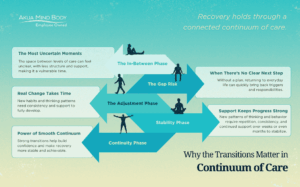
To understand why continuity matters, it helps to look at what happens between levels of care. These are the moments when one phase ends and another has yet to begin, and they are often where progress can feel most uncertain.
When someone completes detox without a clear next step or leaves residential care without structured follow-up, the shift back into everyday life can be difficult to manage. Familiar environments, responsibilities, and triggers return quickly, often before the skills developed in treatment have had time to fully take hold.
New patterns of thinking and behavior take time to develop and stabilize. They require repetition, consistency, and continued support over weeks or even months.
Without that support, it becomes harder for those new patterns to take root, even when meaningful progress has been made. This is why transitions between levels of care carry such importance. Each phase is meant to prepare for the next, allowing individuals to build confidence gradually rather than being expected to manage everything at once.
Recovery tends to feel more stable and achievable when supported by a well-designed continuum that creates smooth movement between each stage. This continuity becomes especially important in the early weeks after treatment, when outcomes can shift quickly depending on whether follow-up care is in place.
Addressing Co-Occurring Disorders
Another layer of complexity often shapes recovery. Behavioral health rarely involves a single condition, with substance use, depression, anxiety, PTSD, and other mental health challenges frequently overlapping and influencing one another. Clinically, this is understood as co-occurring disorders or dual diagnosis, and it reflects the level of care required for effective treatment.
A comprehensive continuum includes:
- Psychiatric evaluation and medication management for underlying mental health conditions
- Trauma-informed care that recognizes how past experiences shape present behavior
- Family therapy to repair relationships and build a healthier support system
- Life skills training covering everything from financial literacy to communication
- Wellness programming incorporating nutrition, exercise, mindfulness, and stress management
Together, these elements support a more integrated approach to care, addressing both substance use and underlying mental health conditions.
Continuum of Care with Akua
In practice, this kind of continuity depends heavily on how care is structured and delivered over time. The most effective models of care recognize the transition from structured treatment to everyday life and extend support beyond formal treatment. Alumni programs, continued therapy, peer networks, and mentorship help maintain connections as circumstances change.
When challenges arise, individuals are not left to manage them alone, but can continue engaging with support systems that remain available. At Akua Mind Body, this understanding shapes how care is approached from the outset. Rather than treating each phase as separate, the focus remains on continuity, creating a connected path from early stabilization through outpatient care and into longer-term support.
With a single point of entry and individualized treatment planning, the aim is to reduce the friction that often exists between stages, so recovery can move forward without unnecessary interruption. If you or someone you care about is struggling with substance use, reaching out for help is the first step.
Recovery is strongest when it is supported continuously, with each stage connected to what comes next.
You might also like

Breathwork: How Learning to Breathe More Intentionally Can Support Wellbeing
Reading Time: 6 MinutesOf all the things that keep us alive, breathing may be the one we notice the least, yet within this automatic act lies one of the most accessible ways we can influence both mind and body. Breathing is one of the body’s most remarkable functions, constantly working to regulate energy, focus, and emotional balance. When […]
The Science of Sound Healing: Bridging Ancient Wisdom and Modern Behavioral Health
Reading Time: 6 Minutes“Sound is the medicine of the future.” – Edgar Cayce Nearly a century ago, Edgar Cayce, known as the ‘Sleeping Prophet’ and often regarded as a pioneer of holistic healing, suggested that sound would one day play a significant role in medicine and healing. At the time, the idea sounded speculative, even mystical. Today, however, […]

Virtual IOP in California, What to Expect
Reading Time: 8 MinutesLearn how online IOP in California works, who it fits, what the schedule looks like, how privacy is handled, and next steps.