
The Science of Sound Healing: Bridging Ancient Wisdom and Modern Behavioral Health
“Sound is the medicine of the future.” – Edgar Cayce
Nearly a century ago, Edgar Cayce, known as the ‘Sleeping Prophet’ and often regarded as a pioneer of holistic healing, suggested that sound would one day play a significant role in medicine and healing. At the time, the idea sounded speculative, even mystical. Today, however, that prediction feels increasingly relevant.
Across behavioral health clinics, trauma centers, and neuroscience laboratories, researchers are starting to understand sound not as background noise, but as a biological tool capable of influencing the nervous system, regulating mood, and altering brain activity. In the West, this is most commonly called Vibroacoustic Therapy (VAT).
In the East, the same idea has existed for centuries through traditions that view the body as a system of energy, rhythm, and vibration. The language differs, but the insight is the same: sound is not merely something we hear, it is something we feel at a cellular level, and that felt experience can be harnessed for healing.
Unlike talk therapy or conventional meditation, sound healing does not ask you to think harder, articulate your pain, or consciously try to relax. It works directly with the body, meeting people where they are.
- Why the Body Responds to Sound
- How Sound Changes the Brain
- The Vagus Nerve and the Stress Response
- Why Sound Matters in Behavioral Health
- Sound and the Conditions That Travel with Mental Health
- Common Healing Frequencies
- Sounding Off…
Why the Body Responds to Sound
Think of the body not as a machine, but as a living instrument, always vibrating, pulsing, and responding to its environment. The heart beats in a pattern. The lungs expand and contract. The brain sends electrical signals in waves. When healthy, these systems coordinate harmoniously. Chronic stress, trauma, and illness can pull those rhythms out of alignment, manifesting as physical tension, emotional dysregulation, and cognitive impairment, the body’s internal symphony falling out of tune.
Sound healing is premised on the idea that carefully selected frequencies may help the body recalibrate. This is not a new idea. Eastern philosophy holds the concept of Nada Brahma (the world is sound), asserting that health is, in part, a function of harmonic resonance. For centuries, healers in India, Tibet, and China have used singing bowls, gongs, and drums to restore that resonance when illness disrupts it.
Modern science has arrived at a related conclusion. Because the body is roughly 70 percent water, and water conducts vibration exceptionally well, low-frequency sound waves travel through muscles, connective tissue, and fluid, producing effects that extend beyond what we consciously hear.
This is why people describe sound therapy as feeling like a massage from the inside out. In clinical settings, Vibroacoustic Therapy uses this directly: participants lie on a mat or chair embedded with transducers transmitting low-frequency waves through the body, with observed effects including muscle relaxation, improved circulation, and reduced physical tension.
How Sound Changes the Brain
One of the most compelling mechanisms behind sound healing is entrainment, the physics principle by which one oscillating system synchronizes its rhythm with another. The brain is no exception. It generates electrical activity in patterns called brainwaves, and different brainwave frequencies correspond to distinct mental states:
- Beta (14-30 Hz): Active thinking, and when sustained, anxiety and overthinking
- Alpha (8-13 Hz): Calm, relaxed alertness
- Theta (4-8 Hz): Deep relaxation and emotional processing
- Delta (0.5-4 Hz): Deep, restorative sleep and physical repair
When a person listens to a steady, repetitive sound a gong, a singing bowl, or a drum, the brain may synchronize its electrical activity with those external rhythms, a process called brainwave entrainment. Rather than forcing the mind into stillness, a paradox for anyone with anxiety or trauma, the sound gives the brain a rhythm to follow, and its natural tendency toward entrainment does the rest.
This is why people often feel measurably calmer within minutes of a sound bath, and why sound often feels more accessible for those who find conventional meditation frustrating.
The Vagus Nerve and the Stress Response
Sound healing may also work through the vagus nerve, the body’s longest cranial nerve, running from the brainstem through the throat, heart, lungs, and gut. It is the primary conduit of the parasympathetic nervous system, responsible for the “rest and digest” response. When activated, it signals that the threat has passed: heart rate slows, breath deepens, muscles release.
Many people living with chronic stress, trauma, or depression exist in a persistent “fight or flight”; the alarm system stays switched on long after the stressor has passed. Because the vagus nerve passes close to the ears and throat, certain sound-based practices appear to stimulate it. Research has found that humming lowers stress and heart rate while increasing heart rate variability (HRV), a key indicator of autonomic nervous system health. Chanting, toning, singing bowls, and slow rhythmic drumming produce similar effects.
The clinical significance of vagal stimulation is already established: physicians use implanted vagus nerve stimulators to treat medication-resistant depression and epilepsy. Sound healing is being explored as a non-invasive way to influence the same system, without surgery or medication.
Why Sound Matters in Behavioral Health
Mental health conditions do not only affect the mind, they inhabit the body. Someone with anxiety carries it as constricted breathing and a chronically tense jaw. Someone with PTSD feels physiologically unsafe even in objectively safe environments. Someone with depression describes not just emotional emptiness but physical heaviness and disconnection from their own body.
Traditional therapy offers invaluable tools at the level of thought and narrative. But for people living with trauma, especially, talking can be destabilizing before a baseline of nervous system regulation is established. The body reacts before the mind can explain, and requiring someone to verbalize pre-verbal pain before they are ready can retraumatize rather than heal.
Sound offers a different entry point, starting with the nervous system, not cognition. By helping the body feel briefly safe and calm, it prepares the ground for deeper therapeutic work. Pleasant, resonant sound also encourages the release of dopamine and serotonin, neurotransmitters central to mood and motivation.
A published study found that after a single singing bowl session, participants reported significantly lower tension, anger, fatigue, and depressed mood, from an intervention requiring nothing beyond a willingness to be present. No explaining, no homework, no revisiting painful memories before you are ready. You simply listen.
Sound and the Conditions That Travel with Mental Health
Mental health rarely arrives alone. Anxiety comes with insomnia. Trauma comes with chronic physical tension. Depression comes with fatigue and difficulty concentrating. Sound therapy is showing promise across all of them.
Sleep: Disordered sleep is the most universal comorbidity in behavioral health, both a symptom of anxiety, depression, and trauma, and a driver of them. Low, repetitive tones may facilitate the brain’s natural descent into Delta wave states, supporting deep restorative sleep without adding medication to an already complex treatment picture.
Chronic Pain: The relationship between chronic pain and mental health is bidirectional; each makes the other worse. Sound therapy may interrupt that cycle through the Gate Control Theory of Pain: when the body receives steady low-frequency vibration, the nervous system may allocate less bandwidth to pain signals. A clinical study on fibromyalgia found that twice-weekly vibroacoustic sessions over five weeks produced significant improvements in pain scores, sleep quality, and daily functioning.
Attention and Focus: Attention difficulties are among the most common behavioral health presentations, whether as ADHD or as a secondary effect of anxiety, trauma, or depression. Many people already use background sound intuitively, white noise, rhythmic music, ambient soundscapes, reporting that it supports focus in ways silence paradoxically does not. Early research suggests measurable improvements in sustained attention through targeted frequency stimulation.
Common Healing Frequencies
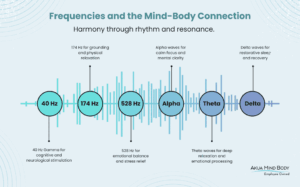
The frequencies used in sound healing come from two distinct places, and it is worth knowing which is which. The brainwave frequencies, Alpha, Beta, Theta, Delta, and Gamma, are well-established in neuroscience and have been mapped through over a century of EEG research. They describe real, measurable brain states, and the idea that sound can shift between them is grounded in a substantial and growing body of neurological research.
The solfeggio frequencies (174 Hz and 528 Hz) have a different origin: ancient musical traditions. The claims around them are less settled, but early research is beginning to ask whether those traditions were pointing at something real.
- 174 Hz: Associated with grounding and physical ease. Widely used in practice; controlled research remains limited.
- 528 Hz: Called the “Love Frequency,” linked to stress relief and emotional balance. A 2018 study found measurable drops in cortisol and increases in oxytocin after five minutes of listening, though evidence remains early-stage.
- Alpha (8-13 Hz): Among the better-studied ranges, showing promise for anxiety reduction in controlled studies.
- Beta (14-30 Hz): Linked to active cognition; being explored for attention and productivity support.
- Delta (0.5-4 Hz): Deep sleep and physical restoration; widely used in sleep support applications.
- 40 Hz (Gamma): Subject of active clinical research at MIT for Alzheimer’s disease and broader neurological health.
The physiological responses to sound, nervous system regulation, brainwave entrainment, and vagal activation are real and measurable even for skeptics. Many people simply notice that certain sounds make them feel calmer and more grounded. That experiential reality is a legitimate starting point.
Sounding Off…
Sound healing is not a cure and not a replacement for therapy, medication, or evidence-based care. What it offers, with growing scientific support, is something complementary, a modality working at the level of the body and nervous system, expanding the toolkit available to clinicians and the people they serve.
Eastern traditions have long described the body as a system of rhythm and resonance requiring tuning, not merely repair. Western science is now saying the same thing in its own language: brainwave entrainment, vagal tone, neurochemical modulation, somatic regulation. The gap between these frameworks has narrowed considerably.
At AKUA, this integrative orientation is central to a holistic approach to behavioral health. Sound healing may be incorporated thoughtfully alongside psychotherapy, psychiatric care, and mindfulness practices, not as a replacement for any of them, but as one more way to help people feel safer, calmer, and more fully present in their own bodies.
Sometimes, perhaps the most radical thing we can do for our health is to simply stop, listen, and let the vibrations do the work.
You might also like
Why Recovery Needs the Continuum of Care to Hold in Behavioral Health
Reading Time: 6 MinutesThe weeks immediately following treatment are often the most fragile part of recovery. Support has changed, routines have shifted, and the structure that once guided each day is no longer there in the same way. What often determines whether progress continues is not simply the treatment someone received, but whether there is another level of […]