

Inpatient vs Outpatient Care: What Actually Fits Your Situation?
Care is one of those words that sounds simple until you have to decide what it really means for you. When dealing with addiction, ongoing substance use, or mental health challenges such as anxiety, depression, or trauma, the level of care required is not determined by preference or convenience, but by clinical acuity, including the severity of symptoms, level of risk, and need for medical or therapeutic support.
Clinical guidance in the United States consistently emphasizes that treatment should be matched to individual need, rather than chosen based on perceived intensity or personal preference. At the same time, people don’t experience these challenges in isolation. Life continues around them, including work, family responsibilities, finances, and the kind of support they have, all of which can shape how things feel day to day.
Some people may continue getting through their routine even when things feel heavier or harder to manage. Others may begin to feel that things are slipping, finding it difficult to keep up in the same way they used to. Research also shows that while many individuals tend to prefer outpatient treatment because it allows them to stay connected to their daily lives, this preference alone does not determine what level of care is appropriate.
Inpatient and outpatient care are part of the same continuum. One offers a structured setting with ongoing support, often needed when safety, stability, or close monitoring becomes important. The other allows individuals to stay in their environment while engaging in treatment, usually when they are more stable and able to participate consistently. This distinction matters because each approach changes how care is experienced.
While clinical need determines the level of care, a person’s circumstances can influence how that care is engaged with and sustained over time, and recognizing when more support is needed is not always straightforward. This is where the distinction between inpatient and outpatient care becomes important, not as a matter of preference, but as a question of what level of support is clinically appropriate and realistically sustainable.
- When Managing Starts Feeling Uncertain
- Inpatient vs Outpatient: Understanding Both Options
- Key Differences in Structure, Intensity, and Daily Life
- Understanding the Trade-offs
- Making Sense and Knowing What You Are Ready For
- Choosing the Right Path with Akua
When Managing Starts Feeling Uncertain
We do not always call it out right away because it’s not always clear enough to act on. So we adjust, push through, and tell ourselves it will pass. For a while, that holds, or at least it seems to. It is easy to assume things are under control. But there comes a point when what used to feel routine starts taking more effort than it should, and the day feels heavier without any clear reason why.
We are still getting through the day, showing up, responding, and keeping things moving. From the outside, nothing looks particularly off. And then certain patterns begin to show up, not dramatically, but consistently enough to notice:
- Functioning, but feeling more drained than before
- Knowing what needs to change, but not being able to sustain it
- The same situations are repeating, even with different attempts to handle them
- Staying on top of responsibilities, but feeling disconnected from them
Many people remain in this space longer than they expect. In the U.S., nearly 1 in 5 adults experience a mental health or substance use condition each year, and many continue without structured support because things may still appear manageable on the surface, even as the need for support increases. This does not always point to a single clear answer.
It brings you to a place most people are not fully prepared for, where the question shifts from what is wrong to what kind of support actually makes sense. That is where the confusion around inpatient and outpatient care usually begins.
Inpatient vs Outpatient: Understanding Both Options
In many conversations, terms like inpatient and outpatient care are used in ways that sound straightforward but often leave room for interpretation when applied to real situations. The difference between them is not always clear on its own, which is why guidance from counselors, therapists, or medical professionals can be an important part of the process. The level of care is determined by clinical factors such as severity, risk, and the level of support required, rather than preference alone.
At times, inpatient care is used interchangeably with residential treatment because both involve stepping away from daily life and staying within a treatment setting. Clinically, there is a distinction. Inpatient care is typically hospital-based and focused on short-term stabilization, often including the detox process before transitioning into longer-term treatment, while residential treatment offers a longer-term, structured environment centered on therapy and recovery.
Because both involve a similar level of immersion, the difference is not always obvious. The terms are easy enough to define, but understanding how they apply to a real situation is where uncertainty tends to remain.
Outpatient care also exists across different levels of intensity. Some programs involve several hours of structured treatment across most days of the week, while others are more flexible yet require consistent participation in care.
At a practical level, it comes down to how care is structured and where it takes place:
- Inpatient care involves living within a treatment setting, where therapy and support are built into the day
- Outpatient care allows you to remain in your environment while attending scheduled sessions and integrating treatment into daily life
This structure allows care to adjust over time, whether at the start of treatment or during a transition back into everyday life.
Key Differences in Structure, Intensity, and Daily Life
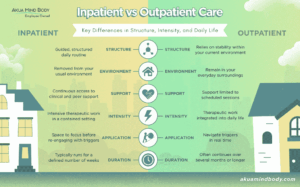
Once the definitions are clearer, it becomes easier to understand how each model works in practice, how care is delivered day to day, and what level of engagement is required. This becomes more evident when you look at how each form of care plays out:
- Structure: Inpatient programs follow a guided routine, while outpatient care relies on a level of stability within your environment
- Environment: Inpatient removes you from your surroundings, whereas an outpatient keeps you within them
- Support: Inpatient offers continuous access to clinical and peer support, while outpatient support is limited to scheduled sessions
- Intensity: Inpatient concentrates therapeutic work within a contained setting, while outpatient spreads that work across everyday life
- Application: Inpatient creates space to focus before re-engaging with triggers, while outpatient involves navigating those triggers in real time
- Duration: Inpatient programs typically run for a defined number of weeks, while outpatient care often continues over several months or longer
Neither option is automatically right or wrong. The appropriate level of care is determined by clinical need, including severity, risk, and the level of support required to engage effectively in treatment.
Understanding the Trade-offs
At this stage, the gap between what seems manageable and what actually works becomes clearer. Real-life demands often reshape expectations, making it important to understand what level of support is required to engage consistently in treatment.
Inpatient Care (Structured, Immersive)
- Built-in structure and routine
- Continuous access to clinical and peer support
- Distance from triggers and daily pressures
- Reduced decision fatigue during early recovery, when even small choices can feel overwhelming
- A higher level of monitoring when needed
At the same time, it requires stepping away from work, responsibilities, and familiar environments. Returning to daily life afterward can take adjustment.
Outpatient Care (Flexible, Integrated)
- Continued participation in work and daily responsibilities
- The ability to apply strategies in real time
- Less disruption to routine and environment
- The option to continue care over a longer period
- Integration of recovery into everyday life over time
That same flexibility requires consistency. Support is limited to scheduled sessions, and staying in the same environment can make it harder to maintain progress, particularly for individuals who require a higher level of support. Because these aspects are not always easy to assess on your own, guidance from counselors or medical professionals can help determine what level of care is appropriate. You can also contact our admissions team with any questions.
Making Sense and Knowing What You Are Ready For
It is easier to compare options than it is to understand what level of support is appropriate. Especially when things do not feel clearly defined, but also do not feel manageable enough to ignore. Readiness is not just about willingness. It is about capacity, your ability to stay consistent and engage with the process, even when it becomes uncomfortable.
In some cases, the question is not where to start, but what level of support allows for consistent engagement in care. The level of care only works if there is enough support to stay with it long enough for it to make a difference. That is why this decision is practical and often difficult. Not just what sounds right, but what level of care is appropriate based on your current needs, environment, and ability to engage in treatment.
The starting point does not have to be perfect, but it should be something that can be adjusted as needs change over time.
Choosing the Right Path with Akua
We understand that this stage rarely comes with complete clarity. Most people arrive with questions, hesitation, and a sense that something needs to change without fully knowing what that change should look like. That is a valid place to begin.
At Akua, care is approached with that understanding, guided by a clinical assessment of each individual’s needs. Some individuals may begin with inpatient support when a higher level of structure and monitoring is required, while others may be recommended for outpatient care when they are stable and able to engage consistently within their environment.
The focus remains on ensuring that the level of care aligns with clinical need while supporting consistent engagement over time. If there is still uncertainty around where to begin, that does not need to be resolved all at once.
What matters is starting with an appropriate level of support and allowing care to adjust as needs change over time.
You might also like

Commit To Treatment During Our Global Health Crisis
Reading Time: 2 MinutesOur world is currently going through an unprecedentedly difficult time. With parents working from home, kids out of school, and the need for social distancing, our mental health, and underlying substance use disorders can be triggered now more than ever. Anxiety, fear of the unknown, depression, isolation, stress, financial difficulties, and boredom can trigger you, […]

How Stigmatizing Language in the Mental Health and Addiction Treatment World Affects Treatment
Reading Time: 3 MinutesLanguage matters, especially when it comes time to mental health and addiction. Fortunately, how we view mental health and addiction has improved dramatically over the past few decades, and even in recent years, we still have a long way to go. For example, many generations have grown up in a society where stigmatizing words such […]

The Importance of Family Involvement During Recovery from Mental Health Disorders
Reading Time: 3 MinutesTeenagers and adolescents are at an increased risk of developing mental health disorders. During this time period in their lives, they are going through a stressful transition. Navigating high school, balancing independence while still being raised by parents, the stress of college admissions and facing peer pressure can contribute to mental health disorders such as […]