

Intrusive Thoughts and Your Mental Health
Intrusive thoughts are unexpected thoughts or images that pop into your head often out of nowhere. They are strange, distressing, unwanted, and often unpleasant. In general, these intrusive thoughts happen to nearly everyone from one time to another and usually, people ignore them and move on with whatever they are doing.
Examples of intrusive thoughts include thoughts of germs, violence, aggression, sexual acts, important incomplete tasks, immorality, or acting out in public. Sometimes people with intrusive thoughts may spend time worrying about what they mean and although they can be disturbing, they generally have no meaning. If you have no intention or desire to act on the thought, and you can easily move on with your day, then it’s probably nothing to worry about.
However, for some people, intrusive thoughts can be a sign of past trauma and the problem with these intrusive thoughts is not the thoughts themselves but the way we may react to these thoughts. Individuals may react to, interpret, or attempt to control the intrusive thoughts which can cause distress, fear, guilt, avoidance, and compulsions, as well as a host of other symptoms including an increase in the frequency or duration of the intrusive thoughts.
What causes intrusive thoughts?
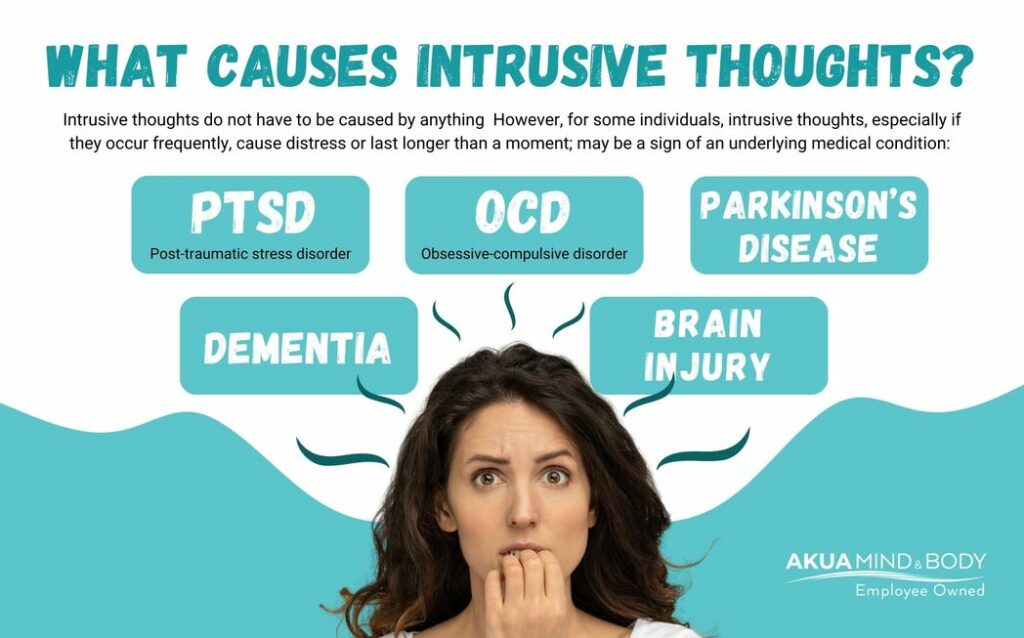
Intrusive thoughts do not have to be caused by anything as they can pop into your mind without any rhyme or reason. However, for some individuals, intrusive thoughts, especially if they occur frequently, cause distress, or last longer than a moment; may be a sign of an underlying medical condition. Medical conditions that may be related to intrusive thoughts include posttraumatic stress disorder (PTSD), obsessive-compulsive disorder (OCD), dementia, Parkinson’s disease, or a brain injury.
OCD and intrusive thoughts
Obsessive compulsive disorder is a mental health disorder that is characterized by having unwanted obsessive thoughts that are relieved by compulsions; specific repeated behaviors that are carried out to suppress or stop the unwanted obsessive thoughts.
Taking action
Intrusive thoughts may be more than just thoughts that keep you awake at night. They may be warning flags that something bigger is affecting you, whether it is past trauma, a current unhealthy stressor in your life or an underlying mental health disorder. Below are some factors to consider regarding your intrusive thoughts:
- Are you experiencing intrusive thoughts? When? How Often?
- How do they make you feel?
- Do you feel that your daily life is affected by these intrusive thoughts?
- Do you have any past underlying causes for these intrusive thoughts?
- Have you talked with anyone (friends or family) about your intrusive thoughts? Have you journaled about your intrusive thoughts?
- Are there any unhealthy triggers (toxic people, drugs alcohol, stressors) that you can eliminate?
- Have you considered seeing a therapist or a mental health professional?
Seeking help or even calling someone at Akua can be a great first step if you are concerned about your mental state. You can speak to our admissions counselors for free to better understand your options and what might work best for you.
You might also like

5 Things They Don’t Tell You About Early Sobriety
Reading Time: 4 MinutesI remember thinking if I could only make it through detox, I would be okay. If I could stay strong and resist my cravings—then in a week or so I would be fine. I would feel “normal” again, whatever that meant. All I needed to do was get through the withdrawals… And part of that […]

The Unexpected Gifts of Sobriety
Reading Time: 3 MinutesThe Unexpected Gifts of Sobriety: Discovering New Passions and Purpose When you hear “sobriety,” what’s the first thing that pops into your head? For lots of us, it’s about what you can’t do anymore, like fun nights out or those spontaneous drinks after work. Let’s flip that idea around. What if stepping away from alcohol […]

Brainspotting: The Science of Healing Trauma
Reading Time: 3 MinutesBrainspotting is a relatively new model of psychotherapy to help individuals overcome trauma. Dr. David Grand founded brainspotting in 2003 after working with individuals who experienced trauma during Hurricane Katrina and the devastating tragedy at the World Trade Center. Brainspotting is based on the theory that the brain can heal itself through eye movements. Sound […]