

Your Inner Critic: Spot It, Shut It Down, & Just Be Nicer to Yourself
Have you ever gotten that nagging feeling someone’s constantly nitpicking everything you do – and that someone is you? That little voice in your head? The one that just loves to tell you you’re not good enough, or that you messed up, again? It’s that tiny narrator up there, right? Picking apart everything from your look to your work. It’ll stack you against literally everyone else, always finding you fall short. And honestly? It can be pretty relentless. That, my friend, is your inner critic. If that sounds like you, then trust me, you are so not alone. While it sometimes pretends to “protect” you, mostly it just chips away at your confidence and peace.
So, how do you even begin to grapple with something so… internal? Well, first off, you’ve got to spot it.
Tune In: What Does This Inner Critic Sound Like?
It usually pops up with the same old tired phrases. Maybe it whispers stuff like:
- “Oh, you always screw this up.”
- “Don’t even bother; you’ll just fail.”
- “Why are you so awkward?”
- “Everyone else has it together but you.”
- “You’re just not smart enough. Or talented enough.”
Notice those harsh, absolute words (“always,” “never”)? It’s judgmental, focused only on negatives. Once you start recognizing these patterns, you’ve made a huge leap. You’re giving the voice a name, separating it from who you genuinely are.
Alright, You’ve Heard It. Now, Fight Back
Hearing it’s one thing. Letting it run your day? Completely different. Here’s how you can begin to push back:
- Demand Proof: Your critic makes a claim. Is it actually true? Or just an old, worn-out story? If it whines, “You always mess this up,” ask, “Did I always? What about that time I nailed it?” Often, the critic wildly exaggerates.
- Talk to It Like a Friend: You’d never speak to a loved one the way your inner critic talks to you, right? So, respond. “Thanks for the input, Inner Critic, but that’s seriously not helping right now.” Or, “I hear you. But I’m still gonna go for it.”
- Find That Tiny Exception: The critic lives for absolutes. “You’re never good enough.” Immediately search for even one instance where that wasn’t true. Even a small counterexample cuts its power.
- Flip the Script: Instead of “Ugh, I failed,” try “Okay, I learned something there.” Instead of “I totally messed up,” maybe “That didn’t quite go to plan, but I can definitely adjust next time.”
And The Big One: Just Start Being Kinder to Yourself
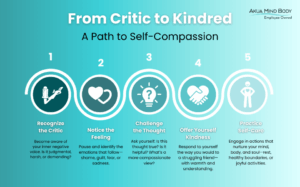
Challenging that critic is crucial. But truly replacing its harshness with genuine compassion? That’s where real change happens.
- Practice True Self-Compassion: Treat yourself with the same warmth, understanding, and support you’d instantly give a good friend. Acknowledge your pain.
- High-Five Those Small Wins: Your critic ignores successes. Actively notice and appreciate even tiny accomplishments.
- Mindful Self-Talk: Consciously choose kinder, more supportive words. Imagine your favorite mentor cheering you on.
- Set Firm Boundaries: Just like you’d draw a line with a negative person, you can tell your inner critic when its opinion just isn’t welcome.
Quieting that inner critic isn’t about being perfect or fooling yourself. It’s about building a healthier relationship with you. It’s about making real space for growth, resilience, and genuine self-acceptance. By truly identifying its pesky voice, challenging its constant harshness, and actively choosing kindness, you start taking back your peace of mind. And then? You truly thrive.
You might also like
Congratulations to our AKUA WARRIORS November 2021
Reading Time: 2 MinutesAkua is grateful for our amazing team of compassionate professionals whose mission is to create an environment of healing and transformation for each client seeking change. Each month we recognize staff that is going above and beyond in providing the highest quality care for our clients. Congratulations to all of the Akua Warriors for November […]

New Women’s Trauma Program by Akua Strong in San Diego
Reading Time: 3 MinutesAkua Mind Body, a recognized leader in mental health and addiction treatment, proudly announces the launch of its innovative Women’s Trauma Program at its established San Diego location. This groundbreaking program offers a unique and powerful blend of evidence-based therapies, personalized care, and holistic healing practices, all within a safe, supportive, and women-only environment. Building […]

The Breakdown on Benzos Addiction
Reading Time: 4 MinutesSedative/hypnotics are a class of medications (mainly prescription) that work on the central nervous system as depressants for individuals with anxiety disorders or sleep disorders. There are two main types of sedative/hypnotics: benzodiazepines and Z-drugs. Common benzodiazepines include Xanax (alprazolam), Librium (chlordiazepoxide), Valium (diazepam), and Ativan (lorazepam). Common Z-drugs include Ambien (zolpidem), Lunesta (eszopiclone), and […]