

Breathwork: How Learning to Breathe More Intentionally Can Support Wellbeing
Of all the things that keep us alive, breathing may be the one we notice the least, yet within this automatic act lies one of the most accessible ways we can influence both mind and body.
Breathing is one of the body’s most remarkable functions, constantly working to regulate energy, focus, and emotional balance. When the diaphragm is fully engaged, breathing becomes deeper, steadier, and more supportive of the body’s natural rhythms. Breathwork brings conscious awareness back to this process, helping people reconnect with a calmer and more intentional way of breathing.
Yet this natural rhythm is easy to lose. Constant stimulation, packed schedules, and the low hum of chronic stress can gradually turn breathing into a quicker, shallower process. The change may seem insignificant, but it can quietly affect everything from sleep and concentration to mood and resilience.
What makes breathwork so compelling is that breathing sits at the intersection of the conscious and unconscious mind. Through structured practices, people can influence stress responses, emotional regulation, mental clarity, and physical relaxation in ways that are increasingly supported by neuroscience, psychology, and integrative health research.
The Rhythm Ahead…
- Why the Nervous System Is the Real Story
- What Breathwork Actually Means
- The Main Forms and How They Work
- The Body and Emotion Connection
- How to Begin a Breathwork Practice
- Let’s Make Breathwork Part of Daily Life
Why the Nervous System Is the Real Story
Breathwork draws much of its power from the way breathing directly influences the autonomic nervous system, the system responsible for regulating heart rate, digestion, stress hormones, and the body’s perception of safety or threat. Most of these processes happen automatically in the background, yet breathing remains one of the few pathways that can consciously influence them in real time.
The nervous system is constantly shifting between states of activation and recovery. During stressful moments, the body increases heart rate, tightens muscles, sharpens alertness, and releases stress hormones designed to help respond quickly. In genuinely dangerous situations, this response is protective.
Problems arise when the body remains in that heightened state for extended periods, responding to emails, deadlines, and overstimulation with the same biological intensity once reserved for survival. Breathing patterns strongly influence which state becomes dominant. Rapid, shallow breathing tends to reinforce stress activation, while slower, deeper breathing encourages the body toward recovery.
Central to this process is the vagus nerve, a major communication pathway connecting the brain to the heart, lungs, and digestive system. Slow diaphragmatic breathing stimulates vagal activity, helping lower heart rate, soften muscle tension, and create a stronger sense of internal stability.
Dr. Stephen Porges, known for developing Polyvagal Theory, spent decades researching how the nervous system interprets safety and danger. His framework suggested that breathing mechanics are deeply connected to emotional regulation and physiological states. Changes in breath rhythm alter the signals sent throughout the nervous system, influencing not only physical calmness but also emotional resilience and social connection.
It’s worth noting that while Polyvagal Theory has been widely influential in clinical settings, some aspects remain debated within neuroscience research. Once breathing is understood as a nervous system tool rather than simply an oxygen-exchange process, the wide range of breathwork practices begins to make much more sense.
What Breathwork Actually Means
The roots of breathwork stretch back thousands of years through traditions such as pranayama in yoga, meditative breathing in Buddhism, and ceremonial practices used across cultures. Modern breathwork combines many of these traditional approaches with contemporary research in psychology, neuroscience, sports performance, and trauma therapy.
What distinguishes breathwork from simple breathing awareness is structure and intention. The pace of the inhale, the length of the exhale, pauses between breaths, and the depth of diaphragmatic engagement all influence the body’s response. Different rhythms produce different outcomes. Breathwork works best when approached with balance and realistic expectations.
Structured breathing practices can support emotional well-being and self-regulation, but they do not replace medical care, therapy, or psychiatric treatment when deeper intervention is needed. More intensive forms should also be approached carefully by people with cardiovascular conditions, respiratory concerns, pregnancy, or significant trauma histories.
The Main Forms and How They Work
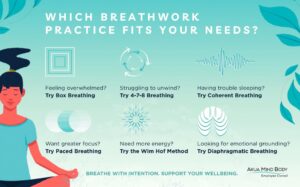
Rather than a single method, breathwork is a family of practices, each designed for a slightly different outcome. Here are some of the most researched and widely used approaches:
Foundation: Diaphragmatic (Belly) Breathing
Instead of lifting the chest during inhalation, the breath expands through the abdomen as the diaphragm fully engages. Research consistently associates diaphragmatic breathing with reduced cortisol levels, improved focus, and a greater sense of physiological balance. Many people notice an immediate feeling of grounding simply by slowing down enough to breathe this way.
Composure Under Pressure: Box Breathing
An even rhythm of inhale, hold, exhale, and hold, often counted in equal intervals of four seconds each. Military personnel, athletes, and emergency responders frequently use this technique because the balanced rhythm encourages mental steadiness and physical calm.
Sleep and Anxiety: 4-7-8 Breathing
Developed by Dr. Andrew Weil, this method uses a four-count inhale, seven-count hold, and eight-count exhale. Longer exhalations activate the parasympathetic nervous system more strongly, making this especially useful for sleep preparation and anxiety reduction.
Heart Rate Variability: Coherent Breathing
Coherent breathing slows respiration to approximately five or six breaths per minute using evenly paced inhales and exhales. At this rhythm, breathing and heart rate begin to synchronize more efficiently, improving heart rate variability (HRV). Research has explored coherent breathing as a supportive practice for anxiety, depression, and chronic stress.
Therapeutic and Intensive: Holotropic Breathwork
Developed by Dr. Stanislav Grof and Christina Grof in the 1970s, this method involves prolonged periods of rapid breathing in guided group settings. Participants often report intense emotional experiences, vivid imagery, and strong physical sensations. Due to its intensity, this approach generally requires professional facilitation and careful screening.
Immune Function and Energy: The Wim Hof Method
Combining forceful breathing cycles, breath retention, and cold exposure, the Wim Hof Method has attracted significant scientific interest. A landmark 2014 study published in PNAS by researchers at Radboud University found that trained practitioners demonstrated measurable influence over inflammatory responses once considered entirely involuntary, marking an important development in understanding mind-body interactions.
The Body and Emotion Connection
While much of the discussion around breathwork focuses on stress reduction, its relationship with emotional processing may be equally significant.
Psychiatrist Bessel van der Kolk in his book ‘The Body Keeps the Score, argues that stress and trauma become embedded not only in memory but also in breathing patterns, posture, muscle tension, and nervous system responses. Physical regulation, therefore, becomes an important part of emotional regulation.
Breathwork supports this process by helping people remain connected to bodily sensations without immediately resisting or suppressing them.
Slow, conscious breathing creates enough internal stability for difficult emotions to move through the body with greater awareness and safety. Emotional regulation becomes less about avoiding discomfort and more about developing the capacity to stay present without becoming overwhelmed.
Researchers Emily Nagoski and Amelia Nagoski discuss a similar concept in Burnout through the idea of “completing the stress cycle.” The body’s stress response was designed to resolve physically, yet modern stressors often remain mentally active long after the triggering event has passed. Structured breathing practices provide a biological pathway toward release and recovery.
For some people, emotional release during breathwork may involve tears, frustration, or unexpected memories surfacing. Experiences like these are often connected to the body relaxing long-held tension patterns, allowing previously suppressed emotional responses to move more fully into awareness.
How to Begin a Breathwork Practice
Beginning a breathwork practice doesn’t require complicated techniques or long daily sessions. A few minutes of intentional breathing each day often creates enough consistency for the nervous system to gradually respond and adapt.
Different breathing methods support different needs:
- For acute stress: Box breathing and slow diaphragmatic breathing can help calm the body’s stress response during overwhelming moments.
- For relaxation and sleep: Coherent breathing and 4-7-8 breathing support the wind-down process and prepare the body for rest.
- For focus and energy: Vigorous diaphragmatic breathing or the Wim Hof Method is often better suited to mornings or periods requiring alertness.
- For emotional grounding: Slow diaphragmatic breathing with extended exhalations can help create a greater sense of stability during emotionally challenging moments.
- For mental clarity: Simple paced breathing, such as inhaling and exhaling for equal counts, may help improve concentration and reduce mental clutter.
- For beginners: Starting with five minutes of natural diaphragmatic breathing is often the easiest way to build familiarity and consistency before exploring more structured techniques.
Breathing through the nose whenever possible also plays an important role. Nasal breathing filters and humidifies air more effectively while supporting a healthier oxygen and carbon dioxide balance within the body. Posture matters as well, since sitting upright or lying comfortably allows the diaphragm to expand more naturally and fully.
It can also be helpful to pair breathwork with existing routines, such as before a morning coffee, during a work break, or as part of a bedtime ritual. Attaching a new habit to an established one often makes consistency easier to maintain. Like any skill, breathwork becomes more natural with regular practice. Small, consistent efforts often create more lasting change than occasional intensive sessions.
Let’s Make Breathwork Part of Daily Life
For something so ordinary, breathing has a remarkable influence on how we experience stress, emotions, focus, and recovery. Breathwork does not require special equipment or dramatic lifestyle changes. Its value lies in its accessibility and its ability to support greater awareness of the connection between mind and body.
As research continues to explore the relationship between breathing patterns, emotional well-being, and nervous system function, breath-centered approaches are gaining recognition within behavioral health and holistic wellness settings. Programs offered through Akua Mind Body reflect this growing interest in practices that support emotional balance and overall well-being.
Perhaps the most compelling aspect of breathwork is its simplicity. By bringing conscious attention to the breath, we can cultivate greater steadiness, awareness, and resilience in everyday life.
You might also like

Neuroplasticity and Recovery: How Exercise and Nutrition Support Brain Healing
Reading Time: 5 MinutesDiscover how neuroplasticity allows the brain to heal in recovery. Learn how exercise, nutrition, and sleep strengthen neural pathways for lasting sobriety.

11 Steps to Consider When Choosing an Addiction or Mental Health Treatment Center
Reading Time: 3 MinutesSo you feel that you or a loved one may be ready for treatment. The next step would be to choose the right treatment facility. If you have done an internet search or had a friend or family member who has been in treatment, you may be overwhelmed by the sheer number of facilities offering […]

Why Recovery Needs the Continuum of Care to Hold in Behavioral Health
Reading Time: 6 MinutesThe weeks immediately following treatment are often the most fragile part of recovery. Support has changed, routines have shifted, and the structure that once guided each day is no longer there in the same way. What often determines whether progress continues is not simply the treatment someone received, but whether there is another level of […]